IELTS Speaking Pronunciation Tips for a Higher Band
What the IELTS pronunciation criterion actually covers, with practical exercises for word stress and rhythm, and an honest look at what AI feedback can and cannot judge.
By English Grader study guides · AI-assisted educational content · Official sources linked below
The short answer
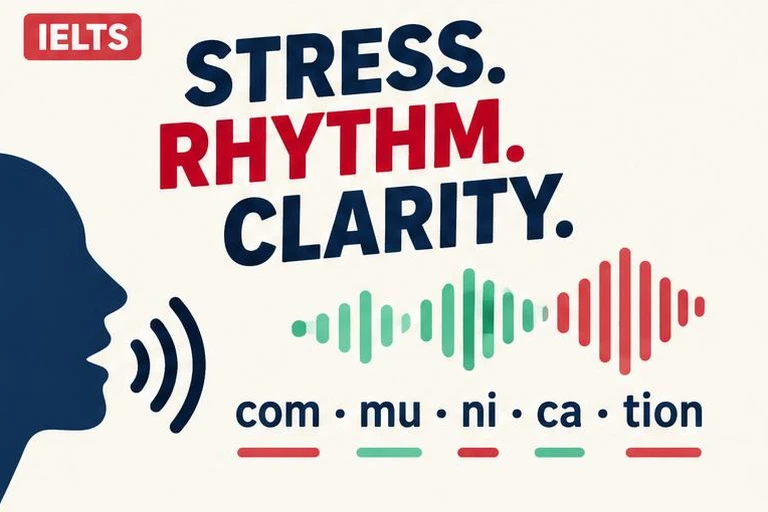
Pronunciation is marked on how easily you can be understood, not on sounding like a native speaker — word stress, rhythm, and intonation matter more than individual sounds.
What the pronunciation criterion actually covers
Pronunciation is one of the four equally weighted IELTS Speaking criteria, alongside fluency and coherence, lexical resource, and grammatical range and accuracy. It is assessed on intelligibility: how easily an examiner can understand you, not whether your accent sounds British or American.
The official descriptors mention features such as word stress, sentence stress, rhythm, intonation, and the use of a range of pronunciation features, rather than perfect production of every individual sound.
This means a strong, clear accent that is easy to follow can score well, while flat, monotone speech with poor stress patterns can hold back a candidate even if individual sounds are accurate.
Practising word stress
English word stress is not predictable from spelling, so it has to be learned word by word, especially for longer or less common vocabulary used in Speaking Part 3. Getting the stress wrong can make an otherwise clear word hard to understand.
A simple daily exercise is to check the stressed syllable of any new word you plan to use in speaking practice, then say it aloud several times exaggerating that stress before using it in a full sentence.
- Nouns and verbs with the same spelling often shift stress: 'record' (noun) vs 'record' (verb), 'present' (noun) vs 'present' (verb).
- Longer academic words often stress a middle syllable: environment, significant, photography.
- Mark stress on your vocabulary notes with a capital letter or underline, e.g. enVIRonment, so it becomes automatic.
Chunking and rhythm
Native-like rhythm comes largely from chunking: grouping words into short meaningful phrases with a brief pause between them, rather than speaking word by word or running everything together.
Reading a short paragraph aloud and marking natural pause points with a slash is a useful exercise, for example: 'I grew up / in a small town / near the coast / so I spent a lot of time / outdoors.'
Practising this way also improves fluency, since it reduces the tendency to pause awkwardly mid-phrase while searching for the next word.
Recording yourself
Most people are a poor judge of their own pronunciation in the moment because they are focused on content, not sound. Recording a short answer and listening back is one of the most effective ways to notice flat intonation, unclear word stress, or a tendency to trail off at the end of sentences.
Compare your recording against a model answer or a native recording of the same topic, focusing specifically on stress and intonation patterns rather than trying to copy every sound exactly.
Record and review your answer →What AI transcript feedback can and cannot judge
AI tools that work from a text transcript of your speech, including feedback based on what you actually said, can give useful guidance on grammar, vocabulary range, coherence, and overall answer structure. These are genuinely valuable areas to improve.
However, transcript-based feedback generally cannot judge the acoustic qualities of your voice, such as exact word stress, intonation contours, or individual sound production, since that information is lost once speech becomes text.
For those finer pronunciation details, recording yourself and comparing against model audio, or working with a speaking partner or teacher, remains more reliable than relying on text-based feedback alone.
Put this into practice
Record a speaking answer with English Grader to work on fluency and clarity alongside your pronunciation.
Guest AI tries are limited to one use per feature per day. Sign in for saved progress. AI feedback and band estimates are practice guidance, not official IELTS results.
Official sources and further reading
Practice examples and study routines are illustrative advice, not official band-scored answers or predictions of exam questions.