IELTS Speaking Part 1 Questions and Answers: How to Prepare Properly
A practical guide to IELTS Speaking Part 1: what the examiner expects, sample questions on common topics, and how to answer naturally without sounding rehearsed.
By English Grader study guides · AI-assisted educational content · Official sources linked below
The short answer
Part 1 rewards natural, slightly extended answers on familiar topics — not memorised scripts.
What Part 1 actually tests
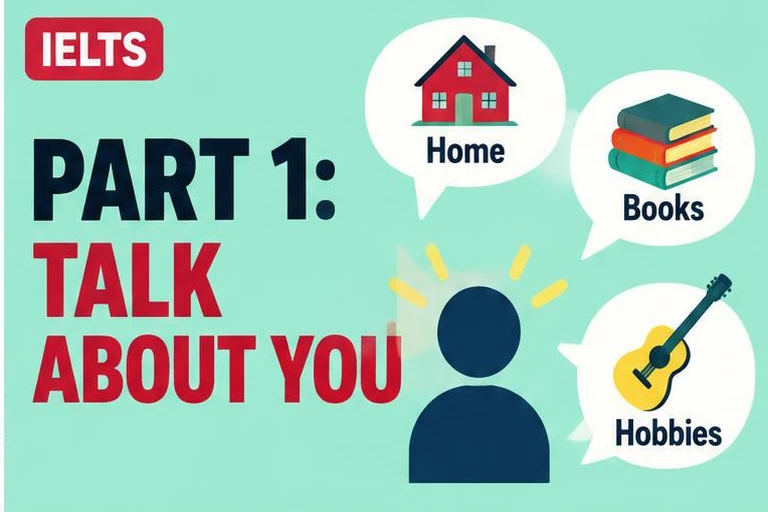
Part 1 lasts around four to five minutes and opens the Speaking test. The examiner asks questions about familiar, everyday topics such as your home, work or studies, family, and free time.
There is no preparation time and no cue card here — you simply answer questions as they come. The aim is to settle you in and get a first impression of your fluency and basic range.
Because the topics are personal and predictable in type, Part 1 is where many candidates could score higher simply by answering more naturally rather than rushing through short replies.
How long should your answers be?
A one-word or one-sentence answer is too short for Part 1. Examiners expect two to three sentences that directly answer the question and add a small amount of relevant detail.
You do not need a long story — that is more suited to Part 2. A good Part 1 answer gives a clear response, then a reason, example or extra detail, and stops there.
Answers that go on too long without being asked can feel unnatural too, so aim for balance rather than maximum length.
- Too short: "Yes, I do."
- Better: "Yes, I do — I usually read in the evenings because it helps me switch off after work."
- Avoid over-explaining simple questions with long, rehearsed-sounding paragraphs.
Sample Part 1 questions by topic
Examiners choose from a bank of topics, but home, work or study, and free time appear very often. Practising a range of questions on each helps you respond without hesitation.
Below is a short set of original practice questions grouped by topic, with one sample answer to show the expected length and style.
- Home: Do you live in a house or a flat? What do you like about your neighbourhood?
- Work/Study: What do you do — do you work or are you a student? Why did you choose that subject or job?
- Free time: What do you usually do at weekends? Have your hobbies changed since you were younger?
Sample answer
"I live in a flat in the centre of my city. I like it because everything is within walking distance, so I don’t need to rely on public transport much."
Extending answers without a script
Memorising full answers tends to backfire because the delivery sounds flat and the content can drift off-topic when the question is slightly different from what you expected.
Instead, practise a flexible pattern: answer, reason, example. This structure works across almost any Part 1 question and still sounds spontaneous.
If you blank on a question, it is fine to pause briefly and think aloud — "That’s an interesting question, let me think" — rather than staying silent or reciting an unrelated memorised line.
Practise this structure with instant feedback →Common mistakes in Part 1
The most common issue is giving answers that are far too short, which gives the examiner little to assess. Another is memorising answers so heavily that they sound unnatural or don’t fit the actual question asked.
Some candidates also try to use overly complex vocabulary that doesn’t suit everyday topics — simple, accurate language is perfectly fine here.
- One-word answers with no development
- Clearly memorised, script-like responses
- Unnatural vocabulary for simple, everyday questions
- Not actually answering the question that was asked
Put this into practice
Try a full Part 1 round with English Grader and get instant feedback on fluency, grammar and vocabulary.
Guest AI tries are limited to one use per feature per day. Sign in for saved progress. AI feedback and band estimates are practice guidance, not official IELTS results.
Official sources and further reading
Practice examples and study routines are illustrative advice, not official band-scored answers or predictions of exam questions.