IELTS Speaking Part 3: Discussion Questions and How to Practise Them
Understand what IELTS Speaking Part 3 expects, practise original discussion questions, and learn how to give balanced, well-reasoned opinions under time pressure.
By English Grader study guides · AI-assisted educational content · Official sources linked below
The short answer
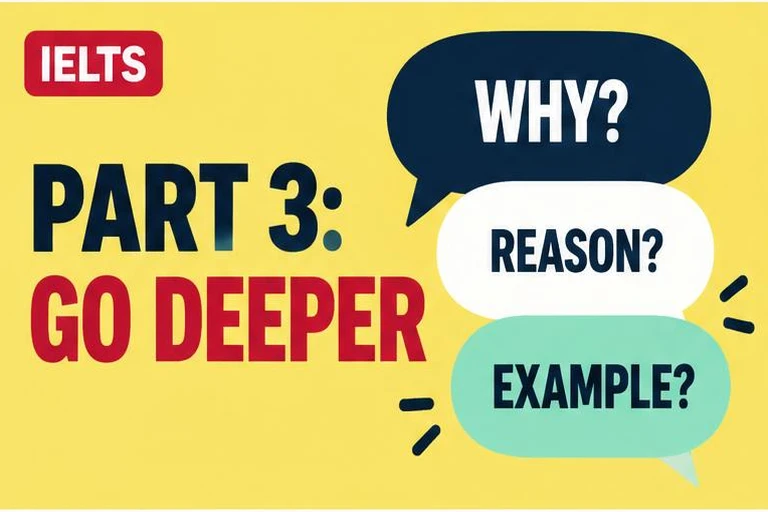
Part 3 is about reasoned discussion, not quick opinions — structure your answers with reasons, examples and balance.
What Part 3 actually tests
Part 3 lasts around four to five minutes and follows directly from Part 2. The examiner asks more abstract, wide-ranging questions linked to the Part 2 topic, pushing the discussion beyond personal experience.
Instead of describing your own life, you are expected to discuss trends, compare situations, and speculate about causes or future changes in society more broadly.
This part carries real weight for the Fluency and Coherence, and Lexical Resource criteria, because it tests how well you can develop and organise more complex ideas on the spot.
Giving opinions with reasons and concessions
A strong Part 3 answer states a clear position, supports it with a reason or example, and often acknowledges another side before returning to your view. This shows range, not just an opinion.
Avoid simply repeating the question back as your opinion — examiners want to hear the reasoning behind your view, not just the conclusion.
Using short concession phrases such as "Of course, some people would argue…, but I still think…" demonstrates a more mature, balanced style of discussion.
- State your view clearly and directly
- Support it with a reason, example or consequence
- Acknowledge a counterpoint if relevant
- Return to your main position to close the answer
Original practice questions
Part 3 questions often move from a concrete theme into wider social, economic or technological territory. Practising a mix of question types builds confidence for discussing unfamiliar angles.
Try the questions below aloud, aiming for thirty to forty-five seconds per answer with a reason and an example.
- Do you think technology has made people more or less sociable?
- How might work patterns change in the next twenty years?
- Should governments do more to protect traditional skills and crafts?
- Why do some people prefer living in cities while others prefer rural areas?
Practise these questions with feedback →Sample answer
"I’d say technology has had a mixed effect. On one hand, it keeps people connected across long distances, which wasn’t possible before. On the other hand, it can reduce face-to-face interaction in everyday life, so I think the overall impact really depends on how people choose to use it."
Comparing and speculating naturally
Many Part 3 questions ask you to compare past and present, or speculate about the future, so having flexible language for both is useful preparation.
For comparisons, phrases like "compared with", "unlike in the past" or "whereas" help you contrast ideas smoothly. For speculation, "it’s likely that", "I’d imagine" and "it could well be that" sound natural and hedge appropriately.
These phrases do not need to be memorised as fixed chunks — practise using a few of them until they come out without conscious effort.
Build this language through regular practice →Handling questions you have no opinion on
It is completely normal to be asked about a topic you have never really thought about. Saying "I’ve never thought about that, but I suppose…" is a perfectly honest and natural way to start.
From there, reason your way to a tentative view using general knowledge or logic rather than specific expertise — the examiner is assessing your language, not your factual knowledge.
Staying silent or refusing to answer is far more costly to your score than giving an imperfect but developed response.
Put this into practice
Work through abstract discussion questions with English Grader and get feedback on how well you develop your ideas.
Guest AI tries are limited to one use per feature per day. Sign in for saved progress. AI feedback and band estimates are practice guidance, not official IELTS results.
Official sources and further reading
Practice examples and study routines are illustrative advice, not official band-scored answers or predictions of exam questions.