IELTS speaking practice online with feedback: a repeatable study routine
Practise IELTS Speaking Parts 1, 2 and 3 online with feedback. Learn what to record, what transcript-based AI can assess, and how to improve your next answer.
By English Grader study guides · AI-assisted educational content · Official sources linked below
The short answer
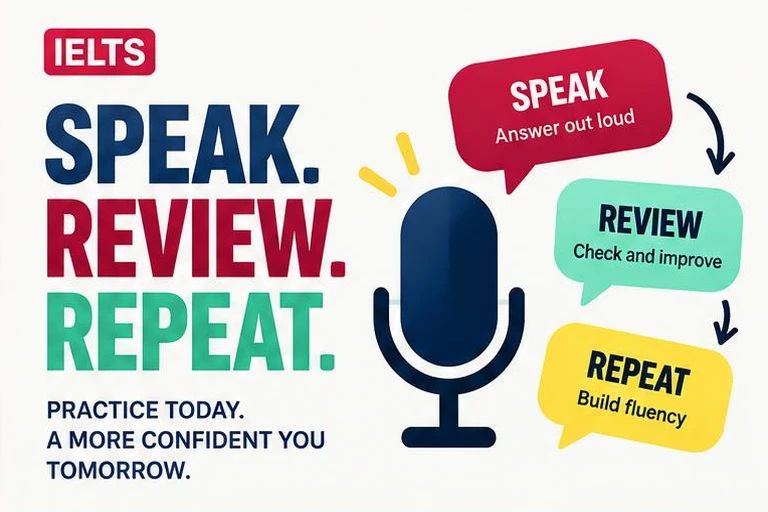
Record first, review one specific weakness, and answer again without reading a script. Listen to the recording yourself: a transcript cannot fully reveal pronunciation or delivery.
Choose the right speaking part before you practise
The IELTS Speaking test is an interview with three parts and lasts 11–14 minutes. Each part asks for a different kind of response. Treating every question as a two-minute speech—or answering every question in one sentence—does not prepare you for those differences.
- Part 1: answer familiar questions about yourself and everyday topics directly, with a relevant detail.
- Part 2: prepare for one minute, then speak for up to two minutes on a cue-card topic.
- Part 3: discuss broader ideas related to Part 2, explaining reasons, comparisons, and consequences.
A focused 15-minute speaking practice session
This is a suggested study routine, not the official test schedule. Choose a question you have not rehearsed. Record your first attempt and resist restarting whenever you make a small mistake; continuing naturally is part of the practice.
Review the feedback, but select only one change for the next attempt. You might explain your reason more clearly, avoid repeating one word, or correct a recurring tense error. Finish by answering a new question to see whether the improvement transfers.
- 2 minutes: choose the part and question; plan only if it is Part 2.
- 3 minutes: record an answer and listen once.
- 5 minutes: review feedback and identify one priority.
- 3 minutes: answer again without a written script.
- 2 minutes: apply the same target to a fresh question.
How to extend an answer without sounding memorised
Use a direct answer, a reason, and a specific example where appropriate. This is a practice scaffold—not an official IELTS formula and not a requirement to use identical phrases in every response. Short Part 1 questions usually need less development than a Part 3 discussion.
Part 1 practice question: Do you enjoy cooking?
Yes, especially at weekends. During the week I usually cook something quick, but on Sundays I like trying a new recipe. Last week I made vegetable dumplings with my sister, which took ages but was worth it.
What online AI speaking feedback can—and cannot—tell you
Official speaking criteria cover Fluency and Coherence, Lexical Resource, Grammatical Range and Accuracy, and Pronunciation. Text-based feedback can help you review relevance, development, vocabulary, and grammar. However, a clean transcript may hide pauses, hesitation, unclear sounds, or speech-recognition errors.
English Grader can transcribe a recorded response and provide tutor-style feedback. Its practice band estimate is not an official score or a complete assessment of pronunciation. Listen for intelligibility, stress, rhythm, and unnatural pauses yourself, and use a qualified teacher when you need a fuller assessment of delivery.
Measure progress through habits, not one score
Compare recordings made under similar conditions. Can you explain an unfamiliar topic without losing the thread? Do you correct a mistake and continue? Are your examples specific rather than repetitive? These questions give you practical evidence that a score alone cannot.
Keep a short list of recurring errors and practise them across different topics. If you want a record of your practice in the app, create an account. Choose a paid allowance only when your routine needs more attempts than the current free limits.
Put this into practice
Choose Part 1, 2 or 3, select a question, and record or type an answer for tutor-style feedback.
Guest AI tries are limited to one use per feature per day. Sign in for saved progress. AI feedback and band estimates are practice guidance, not official IELTS results.
Official sources and further reading
Practice examples and study routines are illustrative advice, not official band-scored answers or predictions of exam questions.