IELTS Speaking Part 2: How to Handle 'Describe a Person' Cue Cards
A practical strategy for IELTS Speaking Part 2 'describe a person' cue cards, with example notes, useful language, and tips for talking for the full two minutes.
By English Grader study guides · AI-assisted educational content · Official sources linked below
The short answer
Build a flexible story template for people — appearance, relationship, personality, a specific memory — and you can adapt it to almost any 'describe a person' card.
A simple strategy for person cue cards
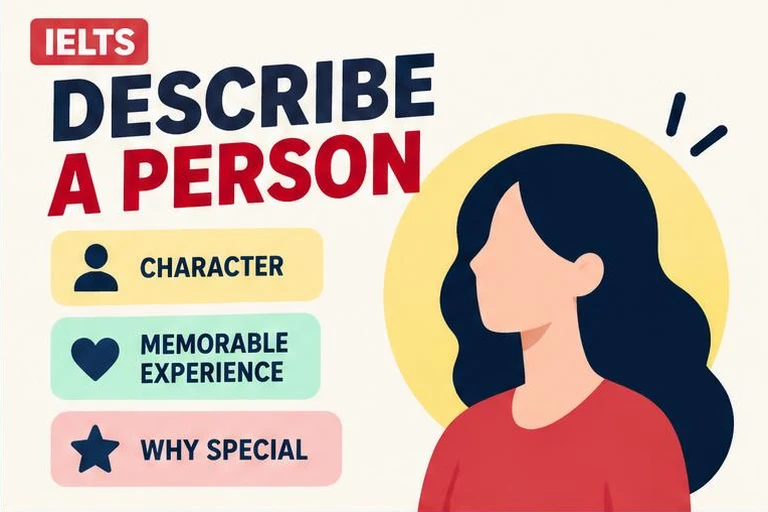
'Describe a person' cards appear constantly in Part 2, often disguised as a teacher, a friend, a family member, or someone who inspired you. The structure underneath is nearly always the same: who they are, how you know them, what they are like, and why they matter to you.
Rather than memorising a script, build a flexible template you can adapt in one minute. Think of it as four slots you fill in differently depending on the card: identity, context, description, and significance.
This approach keeps you talking naturally instead of searching for a pre-written answer that does not quite match the question, which examiners notice immediately.
Original practice cards to try
Practise with a range of 'person' cards so you are not caught out by an unfamiliar angle. Here are three to try this week.
Work through each one with a one-minute preparation limit, exactly as in the real test, then record yourself speaking for up to two minutes.
- Describe someone who taught you an important skill. You should say: who this person is, what they taught you, how they taught it, and explain why this skill has been useful to you.
- Describe a family member you do not see very often. You should say: who they are, when you last saw them, what they are like, and explain how you feel when you do see them.
- Describe a person who has a job you find interesting. You should say: who they are, what their job involves, how you know about it, and explain why you find it interesting.
Useful descriptive language
Examiners reward range, not complexity for its own sake. Moving beyond basic adjectives like 'nice' or 'kind' shows a wider vocabulary without forcing unnatural words into your answer.
Try to vary how you introduce personality traits and physical description so your talk does not sound like a list.
- Personality: easy-going, strong-willed, down-to-earth, quick-witted, reserved
- Appearance: fairly tall, a warm smile, dresses smartly, has a distinctive laugh
- Relationship framing: we've known each other since..., I look up to her because..., he's someone I can always rely on
What one minute of notes should look like
You get one minute to prepare, and a pencil note sheet, not a full script. The goal is a few trigger words that will remind you of a structure under pressure, not full sentences.
Here is an example for the 'teacher' card above, showing how little you actually need to write down.
Sample one-minute notes
Who: Mr. Aldridge, secondary school music teacher What: taught me guitar How: patient, weekly lessons, let me choose songs Why useful: still play now, stress relief, made friends through it
Extending your answer to the full two minutes
Many candidates run out of things to say after 60–70 seconds. The fix is to add a reflective layer on top of the facts: how the relationship has changed, what you would say to that person now, or a specific moment that sums them up.
Adding one concrete memory, with a little detail, almost always buys you an extra 20–30 seconds and makes the answer more memorable for the examiner.
Consistent timed practice is the fastest way to find your own natural stopping points and learn where you tend to need more material.
Record your two-minute answer →Put this into practice
Try a 'describe a person' cue card with English Grader and get instant feedback on fluency, vocabulary, and grammar.
Guest AI tries are limited to one use per feature per day. Sign in for saved progress. AI feedback and band estimates are practice guidance, not official IELTS results.
Official sources and further reading
Practice examples and study routines are illustrative advice, not official band-scored answers or predictions of exam questions.