How to Stop Hesitating in IELTS Speaking
Why hesitation happens in IELTS Speaking and practical ways to sound more fluent, without relying on meaningless filler words.
By English Grader study guides · AI-assisted educational content · Official sources linked below
The short answer
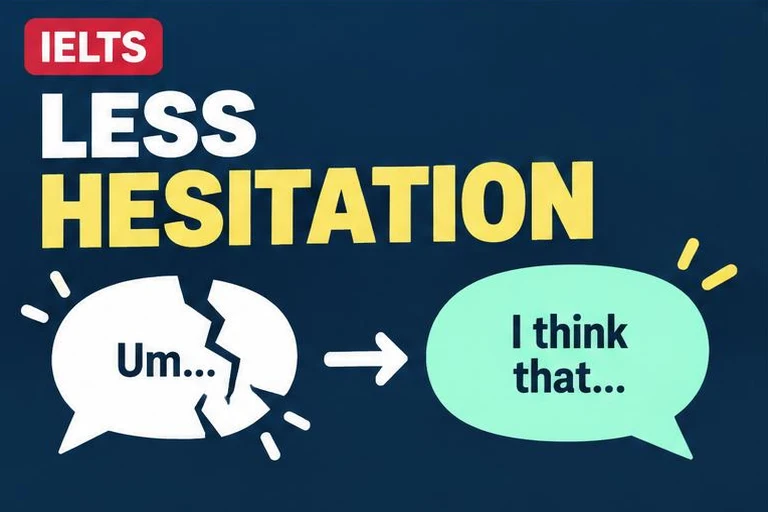
Hesitation usually comes from translating or searching for a perfect word; natural thinking-time phrases and repeated practice reduce it far more reliably than trying to talk faster.
Why hesitation happens in the first place
Hesitation in IELTS Speaking is rarely about not knowing English at all. It is usually caused by two specific habits: mentally translating from another language before speaking, and pausing to search for one perfect word instead of continuing with a slightly simpler one.
Both habits make sense under exam pressure, because candidates worry that an imperfect word will cost marks. In practice, a short pause while you hunt for the ideal word usually costs more than using a plainer word and continuing smoothly.
Fillers versus natural hesitation devices
Not all pausing is bad. Native speakers hesitate too, but they use natural devices that keep the conversation moving, rather than silent gaps or repeated meaningless sounds like "um, um, um". Examiners are listening for this difference when they assess fluency and coherence.
The goal is not to eliminate hesitation completely, which is unrealistic even for fluent speakers, but to replace unproductive filler with short, natural phrases that buy you a moment to think while still sounding connected to the conversation.
- Weak: long silent pauses, repeated "um" or "like"
- Weak: restarting the same sentence three or four times
- Better: "that's an interesting question, let me think"
- Better: "well, I suppose it depends on the situation, but..."
Useful thinking-time phrases
Having a small set of ready phrases removes the need to improvise under pressure. These phrases should sound natural in a conversation, not memorised or overly formal, and should lead into a real answer rather than replacing one.
Practise these phrases until they come out automatically, so that reaching for one does not itself become a source of hesitation.
Practise this question type →Using thinking time naturally
Examiner: "Do you think online shopping has changed how people spend their free time?" Candidate: "That's a good point, actually — I'd say yes, because people now spend time browsing instead of visiting shops in person."
Timed practice and building automaticity
Hesitation drops naturally when a response feels familiar, which is why repeated timed practice matters more than studying vocabulary lists alone. Answering the same type of question under a strict time limit, several times with different topics, trains you to organise an answer quickly rather than searching from scratch each time.
Automaticity, the ability to produce language without consciously constructing every sentence, comes from repetition of similar patterns, not from memorising full answers. Memorised answers tend to break down the moment the question changes slightly.
- Practise the same Part 3 question type with five different topics
- Give yourself only 20–30 seconds to start speaking after each question
- Reuse a small set of flexible linking phrases until they feel automatic
- Record each attempt to check whether hesitation is actually decreasing
How fluency is actually scored
Fluency and coherence is one of four criteria examiners use, alongside lexical resource, grammatical range and accuracy, and pronunciation. It covers how smoothly you speak, how well your ideas connect, and whether hesitation disrupts communication, not whether you speak quickly.
A slower, well-organised answer with occasional natural pausing generally communicates more clearly than a fast answer full of unfinished sentences. There is no guaranteed band score from any single technique, but steadier, better-connected speech is consistently rewarded.
Put this into practice
Answer a timed IELTS Speaking question and see where your fluency breaks down.
Guest AI tries are limited to one use per feature per day. Sign in for saved progress. AI feedback and band estimates are practice guidance, not official IELTS results.
Official sources and further reading
Practice examples and study routines are illustrative advice, not official band-scored answers or predictions of exam questions.