What Examiners Look for in IELTS Speaking Band 7
A breakdown of the four IELTS Speaking assessment criteria at band 7, based on the official band descriptors, with realistic guidance on what to aim for.
By English Grader study guides · AI-assisted educational content · Official sources linked below
The short answer
Band 7 speaking is about speaking at length with only occasional hesitation, using a flexible range of vocabulary and grammar, and self-correcting without losing fluency.
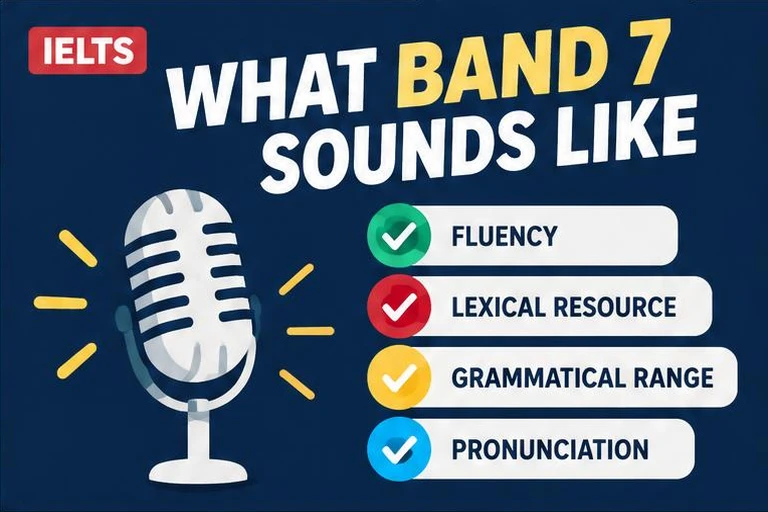
The four criteria at band 7
IELTS examiners assess Speaking against four equally weighted criteria: fluency and coherence, lexical resource, grammatical range and accuracy, and pronunciation. Your final speaking score is the average across all four, so weakness in one area pulls down the overall band.
At band 7, the official descriptors describe a candidate who can speak at length without noticeable effort, use a range of connectives and discourse markers with some flexibility, and use vocabulary flexibly to discuss a variety of topics.
It is worth reading the descriptors for your current target band and the one above it, since this shows exactly what separates the two and where your own answers tend to fall short.
What 'speaks at length without noticeable effort' means
This phrase from the band 7 descriptor does not mean speaking without ever pausing. It means your hesitations are occasional and related to the content of what you are saying, not to a struggle to find basic words or structures.
In practice, this looks like being able to answer a Part 3 question with a developed, multi-sentence response rather than a short, underdeveloped one, and recovering smoothly if you do pause.
- Occasional hesitation while thinking of an idea is normal at band 7; long silences while searching for basic vocabulary are not.
- Self-correction, such as rephrasing a sentence mid-way, is expected and does not lower your score if it does not disrupt fluency.
- Repetition of the same simple sentence patterns across answers is a common sign of a lower band than intended.
Flexible vocabulary, not rare vocabulary
A common misunderstanding is that band 7 requires unusual or 'impressive' words. The descriptor actually asks for flexible vocabulary used to discuss a variety of topics, with some ability to use less common and idiomatic items, and awareness of style and collocation.
This means using the right everyday word precisely, varying your phrasing so you are not repeating the same adjective five times, and occasionally using a natural collocation or idiom where it fits, rather than forcing in rare words that sound unnatural.
Self-correction and grammatical range
For grammar, band 7 expects a range of complex structures with some flexibility, and error patterns that are mostly related to complexity rather than basic mistakes. A few grammatical slips are acceptable if the overall range and accuracy are strong.
This is where self-correction becomes useful rather than something to avoid: noticing and fixing your own tense or agreement error mid-sentence is a sign of good control, not a weakness, as long as it does not derail your fluency.
Realistic preparation for band 7
No single tip or memorised phrase guarantees a particular band score, since examiners assess your performance across a full test, not one answer. The most reliable way to improve is consistent, varied speaking practice combined with honest feedback on where you lose marks.
Focus on extending Part 3 answers with reasons and examples, varying your vocabulary instead of repeating safe words, and listening back to your own recordings to catch patterns you would otherwise miss.
Regular practice against the same four criteria the examiner uses will tell you far more about your level than guessing from a single mock test.
Get feedback on a speaking answer →Put this into practice
Practise a speaking task with English Grader and get feedback mapped to the same four criteria examiners use.
Guest AI tries are limited to one use per feature per day. Sign in for saved progress. AI feedback and band estimates are practice guidance, not official IELTS results.
Official sources and further reading
Practice examples and study routines are illustrative advice, not official band-scored answers or predictions of exam questions.