IELTS Speaking Part 3: how to give longer, developed answers
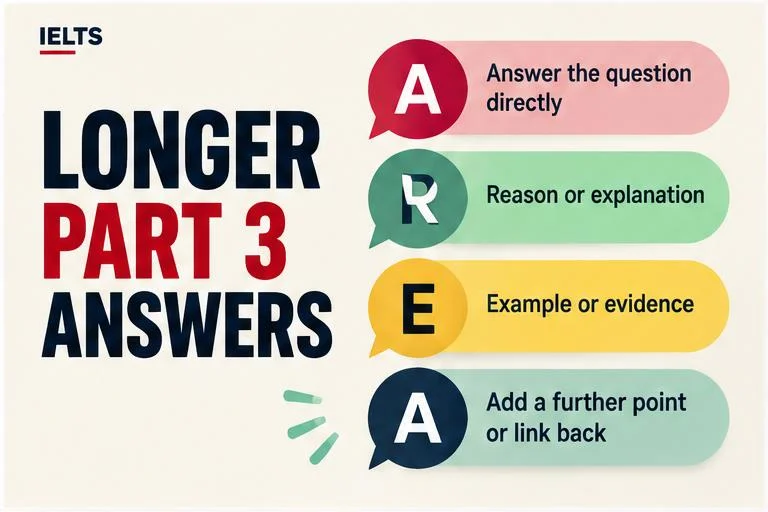
Extend your Part 3 answers beyond one sentence using the A.R.E.A. method: answer, reason, example, alternative.
By English Grader study guides · AI-assisted educational content · Official sources linked below
The short answer
Aim for three to five sentences: answer the question, give a reason, add an example, and—if natural—an alternative view.
The A.R.E.A. method
Part 3 rewards development. A simple structure keeps you talking: Answer the question directly, give a Reason, add an Example, and optionally acknowledge an Alternative view.
- Answer: state your view in one sentence.
- Reason: explain why you think that.
- Example: give a specific case or observation.
- Alternative: mention the other side briefly.
Related guide: Handle opinion questions
A developed answer in action
Notice how each sentence adds something new instead of repeating the same point.
'Do young people read less than in the past?'
Probably, yes (answer). Most entertainment now comes in short video form, which competes directly with books (reason). In my family, for instance, my younger cousins watch clips for hours but rarely finish a novel (example). That said, audiobooks are becoming popular, so perhaps people consume stories differently rather than less (alternative).
Train the habit
Record yourself answering Part 3 questions and count your sentences. If most answers are one or two sentences, practise adding a reason and example before worrying about advanced vocabulary.
Record a Part 3 answer →Put this into practice
Choose a Part 3 question, record a developed answer, and use the feedback to check whether your ideas are extended enough.
Guest AI tries are limited to one use per feature per day. Sign in for saved progress. AI feedback and band estimates are practice guidance, not official IELTS results.
Official sources and further reading
Practice examples and study routines are illustrative advice, not official band-scored answers or predictions of exam questions.