
IELTS Speaking feedback for teachers: combine AI transcripts with listening
Review IELTS Speaking student responses more efficiently using transcription, focused feedback and teacher listening for pronunciation and delivery.
By English Grader study guides · AI-assisted educational content · Official sources linked below
The short answer
Use transcripts to locate language and development problems, but listen to the recording yourself. Text cannot fully reveal pronunciation, pauses or rhythm.
Match the feedback to the Speaking part
A Part 1 answer should respond naturally to a familiar question. Part 2 needs a sustained long turn after one minute of preparation. Part 3 requires a broader discussion of reasons, comparisons and consequences. Avoid using the same answer-length rule for every part.
Assign a specific question and part through your normal teaching routine. Students can practise Parts 1–3 on the Speaking page; teachers can also add audio responses on a student's behalf through teacher uploads.
Choose IELTS Speaking Part 1, 2 or 3 →Check the transcript before judging the language
Speech recognition may omit a word, choose the wrong name or smooth over a hesitation. Compare important phrases with the recording before treating the transcript as evidence of a grammar error. Correct extraction mistakes without rewriting what the student actually said.
The app can transcribe recordings and provide AI feedback. This makes it easier to identify repeated words or weak development, but the analysis should be treated as a first pass rather than a complete oral examination.
- Confirm the task and part.
- Listen for recognition mistakes in key sentences.
- Separate language errors from transcription errors.
- Do not infer pronunciation quality from spelling in a transcript.
Keep pronunciation and delivery in your listening review
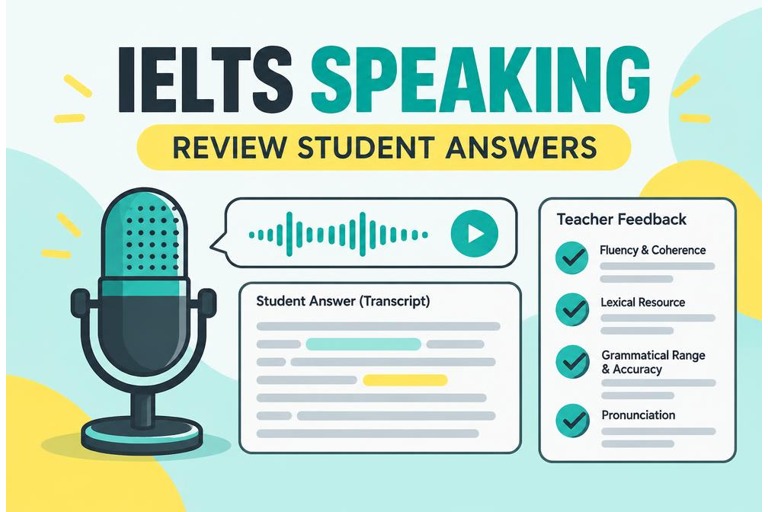
Official Speaking criteria include Fluency and Coherence, Lexical Resource, Grammatical Range and Accuracy, and Pronunciation. A transcript may help with vocabulary and grammar, but it does not capture all hesitation, stress, rhythm or intelligibility. A confident practice estimate cannot remove that limitation.
On the public Speaking page, a student's current microphone recording can be played back locally. Do not assume that this local playback file is stored in the teacher's answer history. Arrange access to the original audio through your classroom process when you need to listen later.
Add a student Speaking submission →Give one language target and one delivery target
Rather than asking for a completely new memorised answer, set two focused goals. One could concern reasoning; the other could concern an audible habit you observed. Make the next attempt spontaneous, using brief notes only where appropriate.
Illustrative Part 3 teacher feedback
Your answer claims online lessons are convenient but does not explain for whom. Add an example of an adult studying after work. When recording again, pause between ideas instead of rushing through the whole explanation in one breath.
Check whether the target transfers to a new question
A polished repeat of the same answer may reflect rehearsal rather than broader improvement. After revisiting the original response, assign a different question with the same development goal. Listen for clearer reasoning or delivery without requiring identical phrases.
AI band estimates are practice guidance, not official IELTS results. Using AI for the transcript and initial analysis may reduce routine review work, but your own listening remains essential.
Related guide: Compare student progress fairly
Put this into practice
Choose a part and question, record an answer and compare the feedback with what you hear when playing it back.
Guest AI tries are limited to one use per feature per day. Sign in for saved progress. AI feedback and band estimates are practice guidance, not official IELTS results.
Official sources and further reading
Practice examples and study routines are illustrative advice, not official band-scored answers or predictions of exam questions.