
Using an IELTS student error bank: turn repeated mistakes into lesson plans
Use linked students' IELTS error banks and class reports to prioritise feedback, plan targeted activities and check whether corrections transfer to new answers.
By English Grader study guides · AI-assisted educational content · Official sources linked below
The short answer
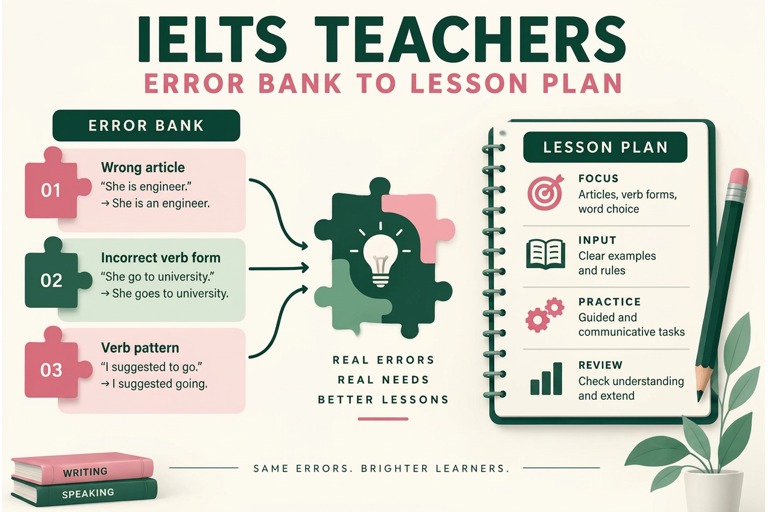
Look for recurring patterns, verify them in the original responses and teach a small skill that students can apply to a new question.
Use error patterns to reduce repetitive explanation
If several students repeatedly confuse articles or leave examples unexplained, you do not need to write the same long explanation on every submission. Teach the shared skill once, then add an individual comment showing where it appears in each response.
English Grader's teacher reports allow linked students' errors and response history to be reviewed. Class information can highlight recurring categories, while individual reports help you check whether the pattern is real and relevant to a particular learner.
Review linked students' IELTS errors →Read examples before accepting the category
An error label is a starting point, not a full diagnosis. 'Grammar' might mean agreement, tense control or a sentence that is difficult to understand. Inspect the original and correction before choosing an activity. If a suggested correction changes meaning or is not appropriate in context, do not teach it as a rule.
Counts also reflect how much work a student has submitted. Someone with many attempts may have more logged mistakes than someone who has barely practised. Compare recurring patterns and their effect on communication, not raw totals alone.
- Check the original sentence and intended meaning.
- Confirm the correction is valid in context.
- Group similar patterns, not just broad labels.
- Consider the number and type of submitted attempts.
Build a short diagnose–practise–transfer lesson
Start with anonymised examples and ask students to explain the problem. Follow with a controlled repair, then a new sentence or paragraph where the same skill is needed. End with a fresh task so you can see whether they can apply it without a visible correction.
Class AI analysis can suggest common weaknesses, groupings and a lesson plan when requested. Review its recommendations against the actual responses; treat the plan as editable teaching material, not an automatic decision about students.
Use class analysis to draft lesson priorities →Suggested mini-lesson: verb agreement
Notice: 'She go to university.' Repair: 'She goes to university.' Apply: write two sentences about another person's daily routine. Transfer: answer a new Speaking Part 1 question without reading a script.
Use anonymised examples and private notes carefully
Ask permission before sharing a student's identifiable work with the class. Removing a name may not be enough if the response includes personal details. Choose short extracts and keep the focus on the language pattern rather than on who made the mistake.
The teacher workspace separates student-visible notes from private teacher notes. Put the actionable learning target in the student-visible area; keep planning observations and sensitive context out of comments you intend students to read.
Related guide: Create student-friendly homework feedback
Check the next response, not just the correction exercise
A student can repair a highlighted error yet repeat it during timed writing. Set a new question with the same target, then compare the original responses. If the pattern persists, adjust the lesson rather than repeatedly generating more feedback.
Use error banks to focus attention and reduce duplicate explanations. They are not a measure of intelligence, effort or guaranteed exam readiness.
Choose a fresh IELTS Writing question →Put this into practice
Open a linked student's report, review their logged errors and original responses, then choose a focused lesson target.
Guest AI tries are limited to one use per feature per day. Sign in for saved progress. AI feedback and band estimates are practice guidance, not official IELTS results.
Official sources and further reading
Practice examples and study routines are illustrative advice, not official band-scored answers or predictions of exam questions.