IELTS Writing Task 2: Common Grammar Mistakes That Cap Your Score
The grammar errors that most often hold back IELTS Writing Task 2 scores, with wrong-to-right examples and a five-minute proofreading routine.
By English Grader study guides · AI-assisted educational content · Official sources linked below
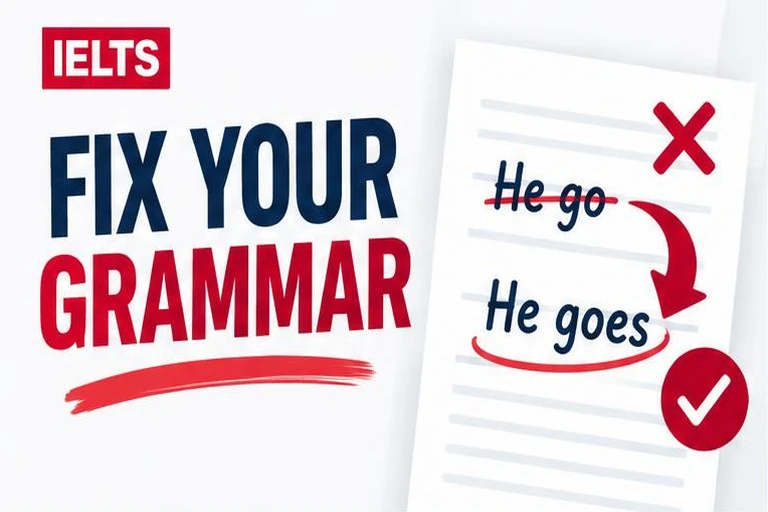
The short answer
A handful of recurring grammar errors, not a lack of advanced vocabulary, are usually what keeps Task 2 scores from moving up a band.
Why these mistakes matter so much
Grammatical Range and Accuracy is one of four equally weighted criteria in Writing, so repeated basic errors can hold back your band even when your ideas and vocabulary are strong. Examiners are specifically trained to notice patterns of error, not just isolated slips.
The good news is that most scripts are limited by a small set of recurring mistakes rather than a huge range of problems. Fixing these few patterns often has a bigger effect on your score than learning new grammar structures.
Five mistakes that appear again and again
Articles (a, an, the) are misused or omitted more than almost any other feature, especially before abstract nouns and in generalisations. Subject-verb agreement slips are also common, particularly with long subjects where the verb ends up matching the nearest noun rather than the real subject.
Countable and uncountable nouns cause frequent errors, such as adding “-s” to uncountable nouns like information or advice. Verb forms after modal verbs are often wrong, and very long sentences joined only by commas, known as run-on sentences, blur the logic an examiner is trying to follow.
- Articles: missing or wrong “a / an / the”
- Subject-verb agreement with long or complex subjects
- Countable vs uncountable nouns
- Verb form after modal verbs (can, should, must)
- Run-on sentences with no clear boundary
Wrong versus right: quick fixes for each mistake
Seeing the correction next to the error makes the pattern easier to remember than a grammar rule alone. Read each pair below and notice exactly which word changes.
Wrong → Right
Articles: “Government should invest in public transport.” → “The government should invest in public transport.” Subject-verb agreement: “The number of students who fail the exam are increasing.” → “The number of students who fail the exam is increasing.” Countable/uncountable: “She gave me several advices about the interview.” → “She gave me several pieces of advice about the interview.” Verb form after modals: “Students should to study every day.” → “Students should study every day.” Run-on sentence: “Technology has changed education, it has made learning more flexible, students can now study from home.” → “Technology has changed education. It has made learning more flexible, and students can now study from home.”
Proofreading in the last five minutes
Do not try to reread the whole essay for every type of error at once; instead, scan it once for each mistake category above, starting with the ones you know you make most often. This is faster and catches more errors than one slow, general read-through.
Pay particular attention to your topic sentences and conclusion, since these are the sentences an examiner reads most carefully. A clean final sentence leaves a better impression than a messy one, even if the rest of the essay is strong.
Practise proofreading a timed essay →Build a personal error list from your feedback
Rather than studying grammar in general, keep a short, running list of the specific mistakes that appear in your own corrected essays. Most learners find that two or three error types account for the majority of their grammar issues.
Review this list before every practice essay and check deliberately for those patterns as you write, not only afterwards. Over several essays, this targeted approach tends to produce more visible improvement than generic grammar revision.
- Note the exact sentence, not just “grammar mistake”
- Group errors by type (articles, agreement, etc.)
- Check your top two error types before you submit
Put this into practice
Submit a Task 2 essay and get line-by-line feedback on grammar, not just an overall score.
Guest AI tries are limited to one use per feature per day. Sign in for saved progress. AI feedback and band estimates are practice guidance, not official IELTS results.
Official sources and further reading
Practice examples and study routines are illustrative advice, not official band-scored answers or predictions of exam questions.