
IELTS Reading summary completion: passage words or a word bank?
Answer IELTS Reading summary-completion tasks by checking the source of words, grammar, meaning and limits, with an original worked example.
By English Grader study guides · AI-assisted educational content · Official sources linked below
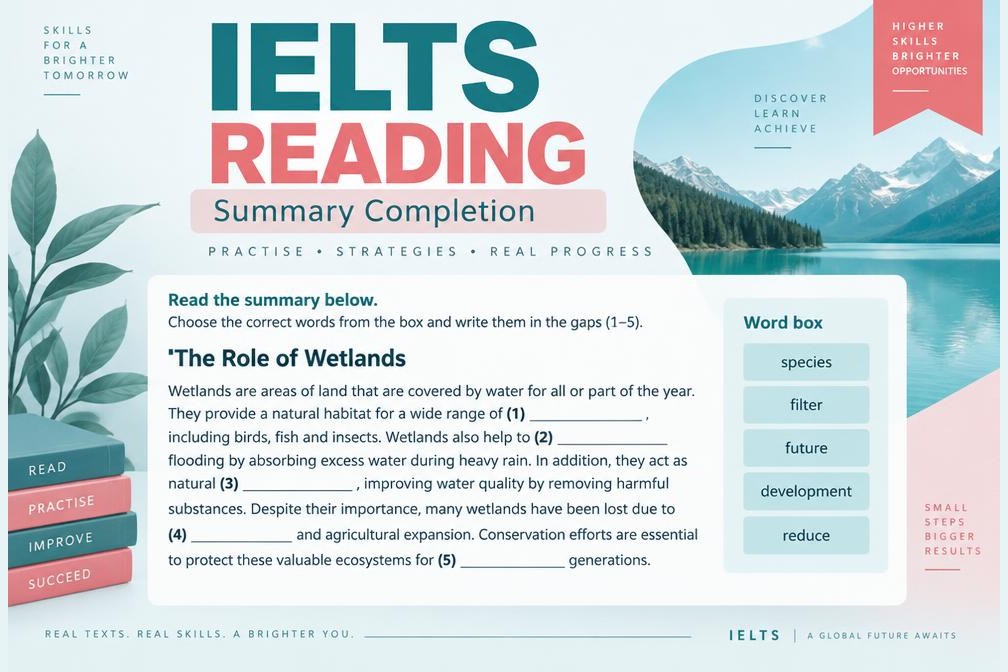
The short answer
First check whether you must take words from the passage or select from a supplied list. Then verify each gap against both grammar and passage meaning.
Read the instruction before predicting a word
Summary-completion tasks can require words from the passage or choices from a list. In a passage-word task, respect the stated word limit and use the wording the task requires. In a list-based task, you may need to enter a letter rather than the word itself. The instruction determines the answer format.
Read the summary as a whole to understand its focus. It often summarises a portion of the passage rather than the entire text. Use the surrounding words to predict whether a gap needs a noun, verb, adjective or number, but treat that prediction as a filter: several grammatically possible words may still differ in meaning.
- Check where answers must come from.
- Predict the grammatical role of each gap.
- Locate the relevant text and confirm the completed meaning.
A worked example: compare meaning with the question
This original illustration explains the decision process. It is not an official IELTS question or a prediction of test content.
Original passage-word example
Instruction: Write ONE WORD ONLY from the passage. Passage: The new roof collects rainwater, which is stored in underground tanks. Summary: Water from the roof is kept in underground _____. Answer: tanks. “Containers” has a similar meaning but is not the passage word requested.
Grammar is a check, not sufficient evidence
An article such as an can narrow possible answers, and a plural verb can suggest a plural noun. But a word can fit the sentence perfectly while representing the wrong information. Read the full clause around the evidence and verify that the summary preserves what the passage says.
Pay attention to plural endings and modifiers. If the gap asks what is stored, answering with the location may sound plausible but fail to answer the intended relationship. Avoid adding extra words “for safety”: exceeding the limit can make an otherwise correct response wrong.
Explain one completed sentence at a time
Rewrite each completed summary sentence in your own words after checking the key. State which passage sentence supports it. For incorrect gaps, label the issue as source, grammar, meaning or instruction. Use the resulting vocabulary in an original spoken sentence so you learn how it behaves, rather than only remembering which blank it filled.
Build IELTS vocabulary for your own answers →Apply what you learn in Writing and Speaking
Turn useful expressions from your reading into your own sentences, then apply them in an original IELTS Writing response. Reading comprehension and writing performance are different skills, so keep practising both rather than assuming improvement automatically transfers.
The tools here provide AI practice feedback and band estimates for Writing and Speaking, not official results. Use a relevant original answer, review a specific weakness and try again. For Reading and Listening tests, use official preparation materials with their audio, passages and answer keys.
Practise IELTS Writing with feedback →Related guide: IELTS Reading time management: when to move on and return
Put this into practice
Use the existing Writing, Speaking and Vocabulary tools alongside official Reading and Listening preparation. This site provides educational guides for Reading and Listening, not tests or automated marking for those skills.
Guest AI tries are limited to one use per feature per day. Sign in for saved progress. AI feedback and band estimates are practice guidance, not official IELTS results.
Official sources and further reading
Practice examples and study routines are illustrative advice, not official band-scored answers or predictions of exam questions.