
IELTS Academic vs General Training Reading: what is different?
Compare the texts, timing and scoring in IELTS Academic and General Training Reading, then choose practice materials that match your booked test.
By English Grader study guides · AI-assisted educational content · Official sources linked below
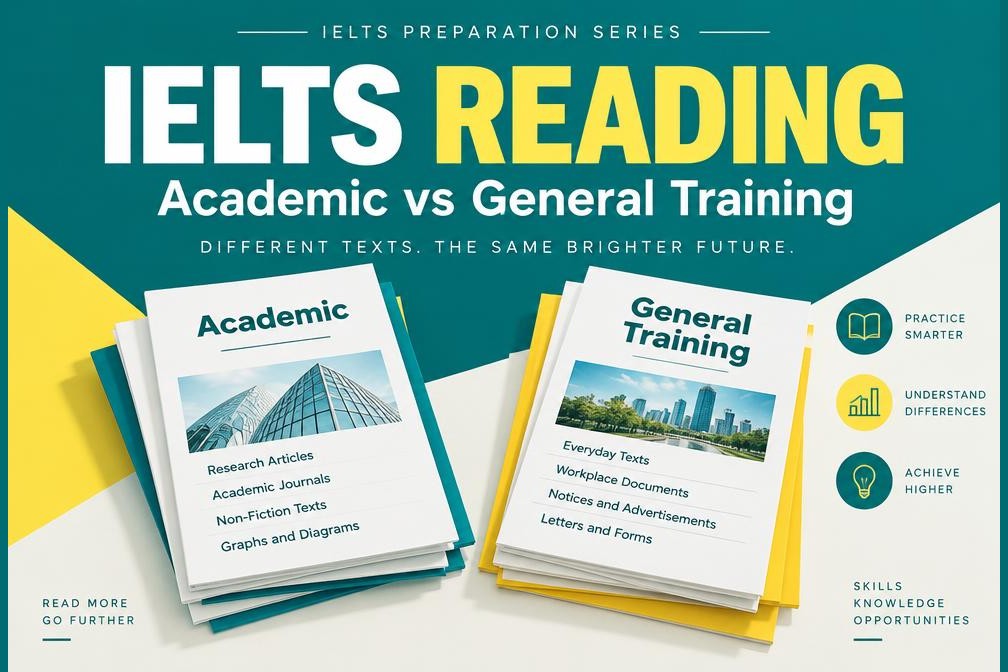
The short answer
Both versions have 40 questions in 60 minutes, but the texts and typical raw-score requirements differ. Prepare for the version your receiving organisation requires.
Choose the test before choosing the materials
Academic Reading uses three longer texts drawn from sources such as books, journals, magazines and newspapers. General Training moves from everyday information to workplace material and then a longer general-interest text. General Training is not simply an Academic paper with easier vocabulary: finding a condition in a notice is a different reading task from following an extended argument.
Check your admission, registration or visa requirement directly. A migration route and a professional registration body may ask for different tests. Do not choose General Training merely because you expect it to be easier. Listening and Speaking are the same in the two versions, while Reading and Writing differ.
- Academic: practise longer explanations, arguments and unfamiliar subject vocabulary.
- General Training: practise notices, workplace policies and longer general-interest texts.
- Both: follow the question instructions, locate evidence and keep answers within limits.
A worked example: compare meaning with the question
This original illustration explains the decision process. It is not an official IELTS question or a prediction of test content.
Original practice comparison
Academic-style sentence: Researchers found that shade reduced surface temperatures. General Training-style notice: Employees must request annual leave at least two weeks in advance. The first asks you to interpret a finding; the second may ask you to locate a deadline or condition.
What changes in scoring?
Each correct answer earns one mark, giving a raw score out of 40. Academic and General Training Reading use different typical conversions. Official IELTS examples associate Band 7 with about 30 correct answers in Academic Reading and about 35 in General Training; precise boundaries can vary between test versions. These are reference points, not a guaranteed conversion for your next practice paper.
When reviewing a practice score, use the key and scoring guidance for that specific material. Comparing an Academic raw score with a General Training chart can create a misleading impression of progress. Keep a record of the version, source and test conditions alongside the score.
Use two materials from the same test version
Complete an official sample task without a dictionary, then explain where the passage supports each answer. Repeat with another task of the same type. If your problem is interpreting conditions rather than unknown vocabulary, focus your next practice on words such as unless, only and except instead of collecting long word lists.
Build IELTS vocabulary for your own answers →Apply what you learn in Writing and Speaking
Turn useful expressions from your reading into your own sentences, then apply them in an original IELTS Writing response. Reading comprehension and writing performance are different skills, so keep practising both rather than assuming improvement automatically transfers.
The tools here provide AI practice feedback and band estimates for Writing and Speaking, not official results. Use a relevant original answer, review a specific weakness and try again. For Reading and Listening tests, use official preparation materials with their audio, passages and answer keys.
Practise IELTS Writing with feedback →Related guide: IELTS Reading True, False, Not Given: evidence before guessing
Put this into practice
Use the existing Writing, Speaking and Vocabulary tools alongside official Reading and Listening preparation. This site provides educational guides for Reading and Listening, not tests or automated marking for those skills.
Guest AI tries are limited to one use per feature per day. Sign in for saved progress. AI feedback and band estimates are practice guidance, not official IELTS results.
Official sources and further reading
- IELTS: Reading test format
- British Council: free official practice tests
- IELTS: scoring in detail
- IELTS: General Training Reading format
Practice examples and study routines are illustrative advice, not official band-scored answers or predictions of exam questions.