
IELTS Reading and Listening mistakes: build a useful review routine
Review IELTS Reading and Listening errors by separating comprehension, instructions, spelling and timing, then choose a focused exercise for the next session.
By English Grader study guides · AI-assisted educational content · Official sources linked below
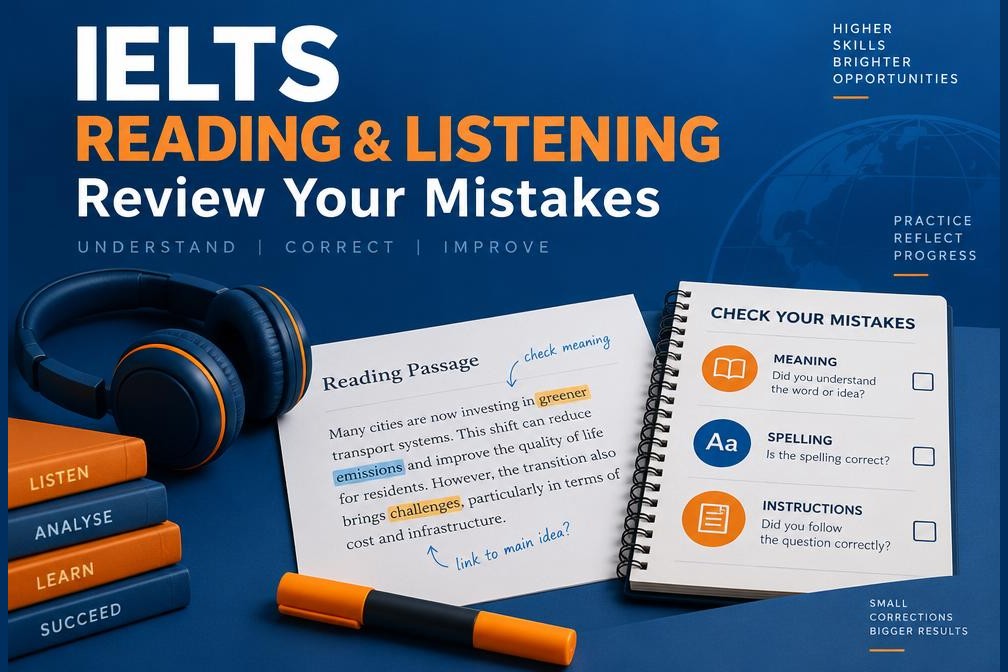
The short answer
Classify each wrong answer before doing another test. A missed paraphrase, an extra word and a rushed guess are different problems and need different practice.
Use four error categories
A raw score shows how many answers were accepted, but not why the others failed. Start with four broad categories: meaning, answer format, written accuracy and timing. One answer can belong to more than one category, but choose the main cause so your next exercise has a clear purpose.
For Reading, return to the sentence that supports the answer. For Listening, use the relevant audio and transcript after your first attempt. If you cannot explain why the key is correct, do not simply copy it and move on. Compare the requested information with the evidence.
- Meaning: missed paraphrase, negation, view or relationship.
- Format: wrong labels, too many words or incorrect response type.
- Accuracy: spelling, a missing ending or an incorrectly recorded number.
- Timing: unanswered items or choices made without checking evidence.
A worked example: compare meaning with the question
This original illustration explains the decision process. It is not an official IELTS question or a prediction of test content.
Original error-log example
Task: Listening form completion. My answer: a notebook. Accepted answer: notebook. Instruction: ONE WORD ONLY. Main cause: answer format, not misunderstanding the audio. Next action: check the current group’s limit before writing. Different case: choosing Thursday when the speaker corrected it to Friday is a comprehension/correction error.
Use scores as trends, not promises
Only compare scores from reasonably similar materials and conditions. Repeating a paper you remember does not measure the same thing as attempting a fresh paper. Reading conversions also differ between Academic and General Training, and exact raw-score boundaries can vary. Use the guidance for the relevant official test material.
Combine score tracking with one behavioural target, such as checking all limits or quoting evidence for every True/False/Not Given decision. A higher score on one easy set does not guarantee a particular exam band, but fewer repeated mistakes can show what is improving.
Choose one targeted follow-up
If you missed paraphrases, compare a few question phrases with their passage or transcript equivalents. If spelling cost marks, practise retrieving those forms. If timing failed, use a checkpoint on a fresh set. Keep your Reading and Listening log yourself: the app’s saved feedback and Error Bank concern supported Writing and Speaking submissions, not imported Reading or Listening test results.
Build IELTS vocabulary for your own answers →Apply what you learn in Writing and Speaking
Turn useful expressions from your reading into your own sentences, then apply them in an original IELTS Writing response. Reading comprehension and writing performance are different skills, so keep practising both rather than assuming improvement automatically transfers.
The tools here provide AI practice feedback and band estimates for Writing and Speaking, not official results. Use a relevant original answer, review a specific weakness and try again. For Reading and Listening tests, use official preparation materials with their audio, passages and answer keys.
Practise IELTS Writing with feedback →Related guide: IELTS Academic vs General Training Reading: what is different?
Put this into practice
Use the existing Writing, Speaking and Vocabulary tools alongside official Reading and Listening preparation. This site provides educational guides for Reading and Listening, not tests or automated marking for those skills.
Guest AI tries are limited to one use per feature per day. Sign in for saved progress. AI feedback and band estimates are practice guidance, not official IELTS results.
Official sources and further reading
Practice examples and study routines are illustrative advice, not official band-scored answers or predictions of exam questions.