
IELTS Reading True, False, Not Given: evidence before guessing
Learn how to separate agreement, contradiction and missing information in IELTS Reading True/False/Not Given, with worked examples and a review routine.
By English Grader study guides · AI-assisted educational content · Official sources linked below
The short answer
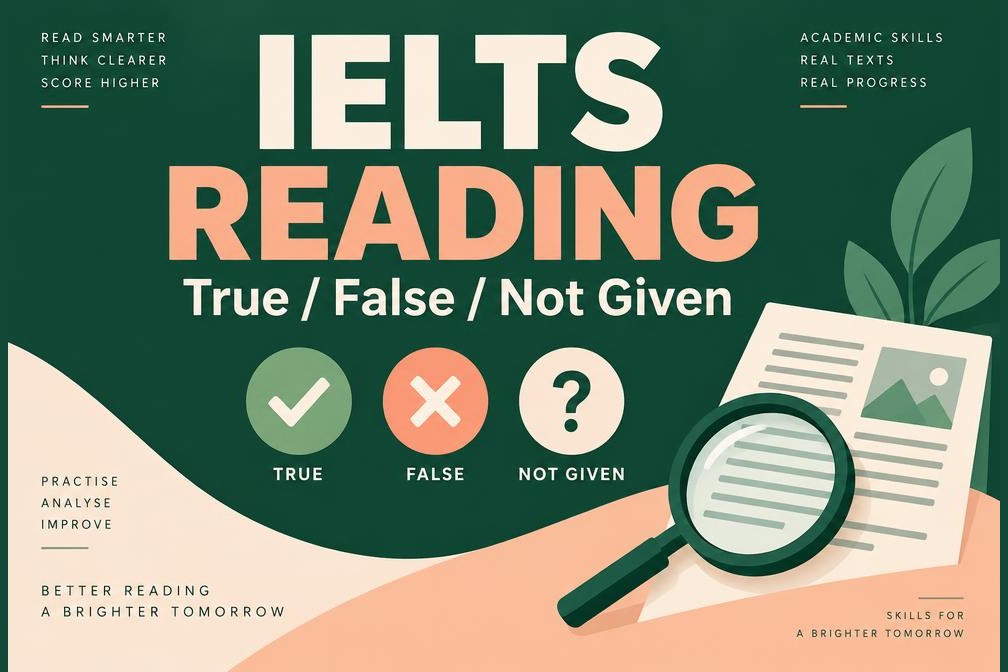
True agrees with the text, False contradicts it, and Not Given means the text does not settle the statement. Your outside knowledge is not evidence.
Turn the statement into a precise claim
Read the whole statement before searching for matching words. Identify who or what it concerns, the action, the time and any quantity or comparison. A statement about all students is not the same claim as one about some students. Once you find the relevant passage, compare those elements rather than counting words that appear in both places.
A paraphrase can be True even if it shares no obvious vocabulary with the text. A sentence containing the same noun can be False because its relationship has been reversed. Not Given is appropriate when a necessary detail is absent, not when the topic feels unfamiliar or the sentence is difficult.
- True: the relevant meaning is supported.
- False: the relevant meaning is contradicted.
- Not Given: neither agreement nor contradiction can be established.
A worked example: compare meaning with the question
This original illustration explains the decision process. It is not an official IELTS question or a prediction of test content.
Original mini-passage and explained answers
Text: The library extended its Saturday hours in June. Sunday opening hours remained unchanged. 1. Saturday hours changed in June. TRUE: this repeats the stated change. 2. Sunday opening hours increased. FALSE: they remained unchanged. 3. Saturday visitor numbers rose in June. NOT GIVEN: opening hours tell us nothing about visitor numbers.
Why False and Not Given get confused
A common mistake is treating lack of support as a contradiction. If a passage says a survey included 200 participants but says nothing about their ages, a statement that they were all teenagers is Not Given. It becomes False only if the text provides incompatible information, such as some participants being over forty.
Words such as mainly, always, first and more than deserve attention, but they are not automatic answer signals. A statement containing always can be True if the passage supports it. Use these words to identify what must be checked, not to create a shortcut that bypasses reading.
Review the evidence, not just the answer letters
After a timed set, write a short reason beside each answer: same meaning, opposite meaning or missing detail. Quote the smallest passage extract that supports your decision. For Not Given, name the missing element. This makes it easier to see whether you repeatedly assume causes, quantities or comparisons that the passage never provides.
Build IELTS vocabulary for your own answers →Apply what you learn in Writing and Speaking
Turn useful expressions from your reading into your own sentences, then apply them in an original IELTS Writing response. Reading comprehension and writing performance are different skills, so keep practising both rather than assuming improvement automatically transfers.
The tools here provide AI practice feedback and band estimates for Writing and Speaking, not official results. Use a relevant original answer, review a specific weakness and try again. For Reading and Listening tests, use official preparation materials with their audio, passages and answer keys.
Practise IELTS Writing with feedback →Related guide: IELTS Reading Yes, No, Not Given: identify the writer’s view
Put this into practice
Use the existing Writing, Speaking and Vocabulary tools alongside official Reading and Listening preparation. This site provides educational guides for Reading and Listening, not tests or automated marking for those skills.
Guest AI tries are limited to one use per feature per day. Sign in for saved progress. AI feedback and band estimates are practice guidance, not official IELTS results.
Official sources and further reading
Practice examples and study routines are illustrative advice, not official band-scored answers or predictions of exam questions.