IELTS complex sentences: examples and structures for a higher grammar score
How to write and speak complex sentences for IELTS Grammatical Range and Accuracy, with clear examples of relative, conditional and concessive clauses.
By English Grader study guides · AI-assisted educational content · Official sources linked below
The short answer
Use a few complex structures accurately rather than many long sentences with errors—accuracy and range are scored together.
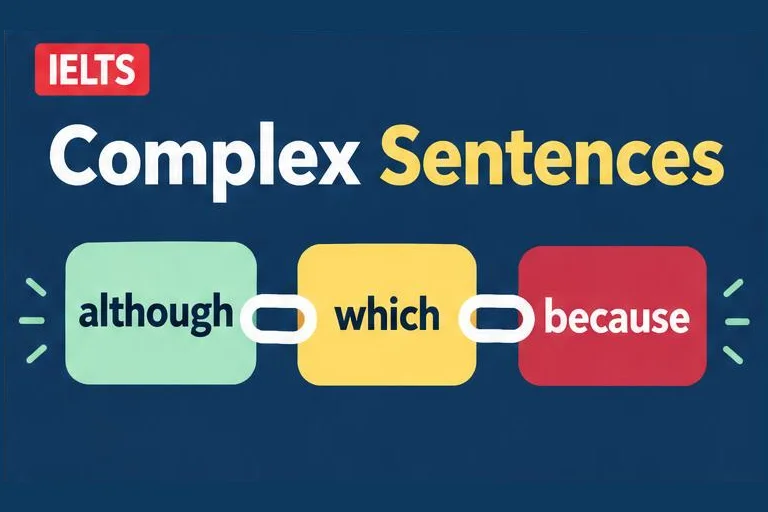
What counts as a complex sentence
A complex sentence has a main clause and at least one dependent clause. For Band 7, examiners expect a variety of complex structures and frequent error-free sentences.
Related guide: Avoid common grammar mistakes
Five structures to master
These cover most Task 2 and Part 3 needs.
- Relative: Students who study abroad often become more independent.
- Concessive: Although cars are convenient, they increase pollution.
- Conditional: If governments invested more in transport, congestion would fall.
- Reason: Because housing is expensive, many young adults live with parents.
- Participle: Having considered both views, I believe…
Simple → complex
Combine related ideas instead of writing short separate sentences.
Practise in a Task 2 essay →Rewrite
Simple: Online learning is flexible. It can be isolating. Complex: While online learning is flexible, it can leave students feeling isolated.
Complex sentences in Speaking
The same structures help in Part 3, where you explain reasons and conditions. Practise one 'if' and one 'although' sentence per answer.
Try a Part 3 question →Put this into practice
Write a Task 2 essay and use the feedback to see how accurately you used complex structures.
Guest AI tries are limited to one use per feature per day. Sign in for saved progress. AI feedback and band estimates are practice guidance, not official IELTS results.
Official sources and further reading
Practice examples and study routines are illustrative advice, not official band-scored answers or predictions of exam questions.