IELTS Linking Words and Cohesive Devices for Band 7
What cohesion really means in the IELTS band descriptors, why overusing linkers can hurt your score, and natural alternatives to the most overused connectors.
By English Grader study guides · AI-assisted educational content · Official sources linked below
The short answer
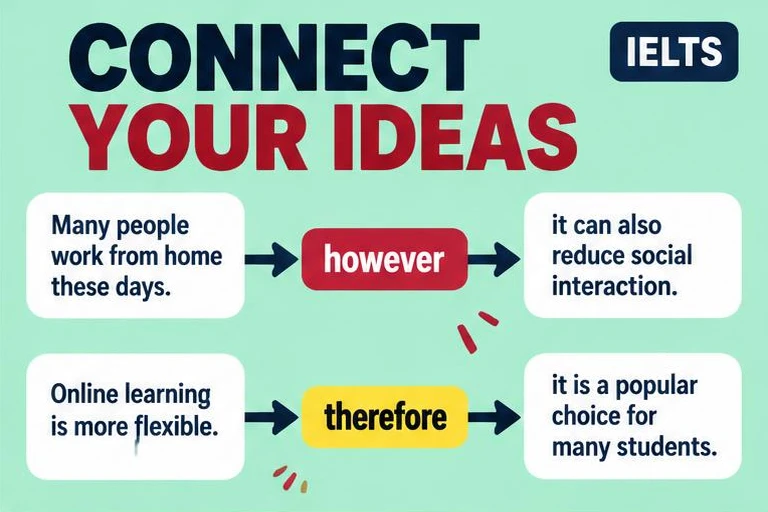
Cohesion is about how clearly your ideas connect, not how many linking words you insert — fewer, well-placed connectors score higher than a list stuffed with ‘Moreover’ and ‘Furthermore’.
What ‘cohesion’ actually means in the descriptors
The Coherence and Cohesion criterion rewards writing where ideas flow logically and the connections between sentences are clear to the reader. It is not a word count of linking phrases you’ve managed to squeeze in.
At higher bands, the descriptor specifically mentions using cohesive devices “flexibly” and with “sufficient variety”, which implies both range and appropriateness — not maximum frequency.
A well-organised paragraph with only two or three linking words can score higher than one crammed with connectors that don’t actually clarify the relationship between ideas.
Why overusing linkers hurts your score
Many candidates open every sentence with “Firstly”, “Moreover” or “In conclusion”, believing this demonstrates organisation. Examiners notice this pattern quickly, and the descriptors explicitly penalise “mechanical” use of cohesive devices.
Overuse also often signals weak underlying logic — the linker is doing the work that clear sentence structure and paragraph planning should be doing instead.
The fix is not to avoid linking words altogether, but to use fewer of them more precisely, letting some connections come from sentence structure rather than an explicit conjunction.
Natural alternatives to the most overused connectors
A short list of commonly overused linkers, with more natural alternatives depending on context, can immediately make your writing sound less templated.
- Instead of always “Firstly… Secondly…” — try “One reason for this is…” then “A further factor is…”
- Instead of “Moreover” in every paragraph — try “In addition,” “What is more,” or simply starting a new sentence that builds on the previous point without any linker.
- Instead of “In conclusion” — try “Overall,” “To summarise,” or restating your position directly without an introductory phrase.
- Instead of “Due to the fact that” — try “because” or “since”, which are shorter and equally formal.
- Instead of “Furthermore” repeated twice in one essay — vary with “Besides this,” or restructure the sentence to combine two ideas with “and” or a semicolon.
Paragraph-level cohesion: reference and substitution
Cohesion isn’t only about connecting words between sentences; it also includes reference (using pronouns like “this”, “these” or “it” to point back to an earlier idea) and substitution (replacing a repeated noun with a shorter form).
For example, instead of repeating “this problem” three times, you might write “this issue” once, then “it” the next time you refer to the same idea, as long as the reference stays unambiguous.
These devices are often what separates band 7 writing from band 6 writing, because they show control over the text as a whole rather than just within individual sentences.
Before and after: fixing a mechanical paragraph
Here is a short paragraph rewritten to reduce mechanical linking and add natural reference instead.
Practise rewriting a paragraph →Before and after
Before: “Firstly, pollution is a big problem. Secondly, it is caused by factories. Moreover, cars also cause pollution. In conclusion, pollution must be reduced.” After: “Pollution is a pressing problem, driven largely by factory emissions and vehicle exhaust. Both sources need to be tackled if air quality is to improve.”
Put this into practice
Submit a paragraph and see whether your linking feels natural or mechanical.
Guest AI tries are limited to one use per feature per day. Sign in for saved progress. AI feedback and band estimates are practice guidance, not official IELTS results.
Official sources and further reading
Practice examples and study routines are illustrative advice, not official band-scored answers or predictions of exam questions.