
Teaching IELTS with Band 6.0 and 7.0 model answers: compare, explain, then write
Use IELTS Writing Task 2 Band 6.0 and 7.0 example answers to teach development, organisation and language control without encouraging memorised essays.
By English Grader study guides · AI-assisted educational content · Official sources linked below
The short answer
Give students a task before showing the models. Compare how the answers develop ideas, then ask for an original response to a new question.
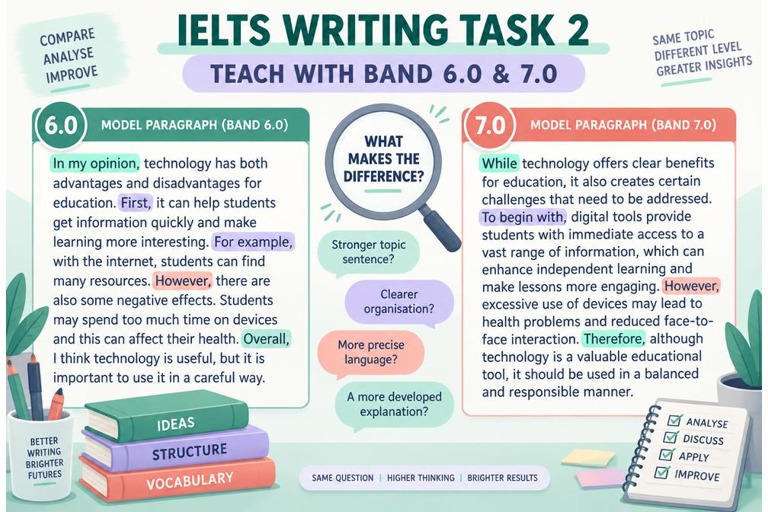
Use two models to teach a specific difference
Paired examples are useful when students can explain what changed. A clearer topic sentence, a better-supported claim or more precise word choice is teachable. A vague instruction to 'sound like Band 7' is not.
English Grader generates Band 6.0 and 7.0 example answers in practice areas and teacher material workflows. These labels describe intended practice levels, not officially certified scores. Read the question and both examples before presenting them as teaching material.
Prepare IELTS model-answer teaching material →Ask students to attempt the task first
Start with a plan or paragraph before showing the examples. Students then have their own decisions to compare: what they selected, how they explained it and where they struggled. If you show a complete essay first, later writing may reveal memory rather than independent control.
Choose a question that matches the current lesson. For Task 2, students can work on a claim, explanation and example. For Task 1, the models must be checked against the visual; never use the essay comparison routine as a substitute for chart accuracy.
Choose an IELTS Writing Task 2 question →Compare meaning and development before vocabulary
Ask students which response gives the reader a clearer reason and why. Look at the relationship between the claim, explanation and example. Then discuss paragraphing, reference words and sentence control. More linking phrases or rarer words do not automatically create a stronger answer.
- Does each answer address the exact instructions?
- Which claim is explained more fully?
- Is the example relevant to the argument?
- Which language choices make the meaning clearer?
Illustrative comparison—not independently band-scored
Brief claim: Online courses are useful because they are flexible. Developed version: Online courses let working adults study outside office hours. For example, someone on a rotating shift can watch a recorded lesson when they are free instead of missing a fixed class.
Use native-language help without removing the English
Students can select a native language to read translated explanations alongside English, with key-word meanings where available. This can support understanding of feedback, but translations may be imperfect. Check an important term if the translation conflicts with the English explanation.
Ask students to explain the difference in their own words, then apply the idea in English. The goal is to understand how an answer works, not to translate and memorise an entire model. Keep the selected language easy to change for mixed-language classes.
Related guide: Follow comparison with targeted error practice
Finish with a new response and teacher-reviewed feedback
Give a fresh question requiring the same skill. Ask students to use the development pattern without borrowing the model's sentences. Compare the new response with their first attempt and identify whether the improvement transfers.
Teacher grading can combine the AI's first-pass analysis with your own band and comments. Use that feedback to choose the next small target. Generated models and practice scores can support teaching, but neither guarantees an exam result or removes the need for professional judgement.
Review students' original IELTS responses →Put this into practice
Generate practice material and Band 6.0/7.0 examples, check the content yourself and adapt it to a specific class objective.
Guest AI tries are limited to one use per feature per day. Sign in for saved progress. AI feedback and band estimates are practice guidance, not official IELTS results.
Official sources and further reading
Practice examples and study routines are illustrative advice, not official band-scored answers or predictions of exam questions.