IELTS Writing Task 2 Time Management: Making 40 Minutes Work
A practical plan for splitting your 40 minutes on Task 2 between planning, writing and checking, plus what to do when you get stuck.
By English Grader study guides · AI-assisted educational content · Official sources linked below
The short answer
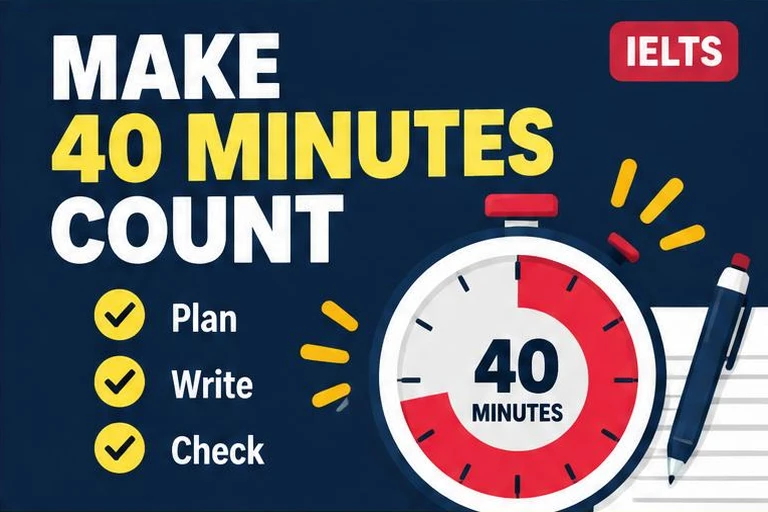
A simple 5-30-5 split keeps your Task 2 essay planned, written and checked within 40 minutes.
The 40-minute reality
In the real test you have 60 minutes for both writing tasks, and most guidance suggests spending about 20 minutes on Task 1 and 40 on Task 2, since Task 2 carries more weight in the overall writing score. That leaves less time than it sounds like once you factor in reading the question carefully and checking your work.
Many candidates lose time not because they write slowly but because they spend too long deciding what to say. Having a fixed internal schedule removes that uncertainty and stops one section eating into another.
A 5-30-5 plan
A workable split is five minutes planning, thirty minutes writing, and five minutes checking. The planning stage is not optional extra time; it is what makes the writing stage faster, because you already know your position and your paragraph order.
During the thirty-minute writing stage, aim for roughly: introduction (3-4 minutes), two body paragraphs (10-12 minutes each), and a brief conclusion (2-3 minutes). These are rough guides, not strict rules, but they stop any one paragraph running away with your time.
- 5 minutes: read the question, decide your position, note 2-3 main ideas
- 30 minutes: write introduction, two body paragraphs, conclusion
- 5 minutes: check grammar, spelling, paragraph linking and word count
What to do when you get stuck
If you freeze on an idea, do not sit and wait for inspiration. Fall back on your own experience or general knowledge connected to the topic; examiners assess how well you develop and support an argument, not whether your ideas are original.
A useful habit is keeping two or three flexible example types in mind before the test, such as a personal example, a general trend, and a comparison with another country or time period, that can be adapted to many topics without memorising whole paragraphs.
Adapting a general idea
For a question on technology and communication, a prepared idea about 'convenience versus personal connection' can be reused for topics on remote work, online shopping or social media with only small adjustments.
Practising under real time pressure
Time management is a skill that improves with repetition under realistic conditions, not by reading about it. Practise full essays with a timer running, rather than writing untimed drafts and only timing yourself occasionally.
It also helps to practise each stage separately sometimes: timing just the planning stage, or just the checking stage, so you learn how much you can realistically achieve in five minutes rather than guessing on test day.
Try a timed Task 2 practice essay →What to check first with limited time
With only five minutes left, you cannot fix everything, so prioritise. Check that you have actually answered the question and taken a clear position, since task response carries real weight in the band score.
After that, scan for obvious grammar slips, repeated words, and missing paragraph breaks. A quick word count check also matters, since an essay noticeably under 250 words can be penalised even if the ideas are good.
- Have you answered every part of the question?
- Is your position clear and consistent throughout?
- Are paragraphs clearly separated with topic sentences?
- Is the word count comfortably over 250?
Put this into practice
Write a timed Task 2 essay and get instant AI feedback on structure, language and task response.
Guest AI tries are limited to one use per feature per day. Sign in for saved progress. AI feedback and band estimates are practice guidance, not official IELTS results.
Official sources and further reading
Practice examples and study routines are illustrative advice, not official band-scored answers or predictions of exam questions.