How to Improve Your IELTS Writing from Band 5.5 to 6.5
What actually separates a 5.5 from a 6.5 in IELTS Writing, the habits that keep scores stuck, and a realistic four-week routine to move upward.
By English Grader study guides · AI-assisted educational content · Official sources linked below
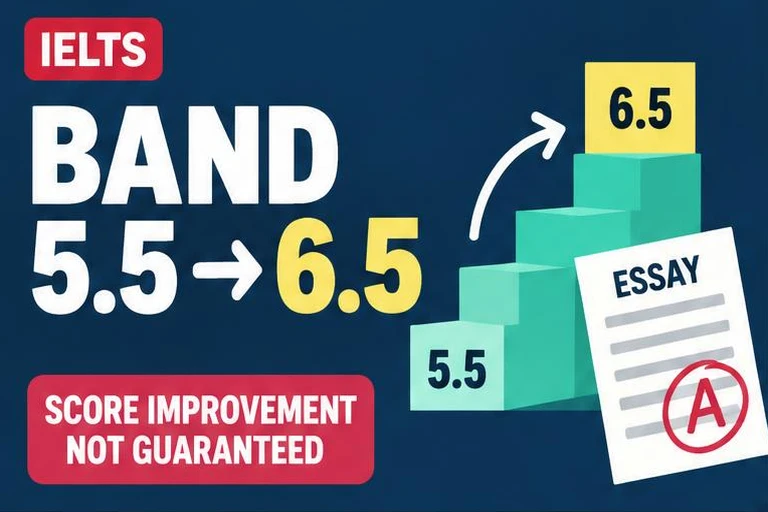
The short answer
Moving from 5.5 to 6.5 usually means fixing a small number of recurring issues, not relearning how to write.
What separates band 5.5 from band 6.5
The official band descriptors assess four areas: task response, coherence and cohesion, lexical resource, and grammatical range and accuracy. A 5.5 typically shows partial control in several of these, while a 6.5 shows generally adequate to good control across all four.
In practice, this often comes down to clarity and consistency rather than ambition. A 6.5 response usually answers the question directly, organises ideas logically, uses a reasonable range of vocabulary with only occasional errors, and mixes simple and complex sentences with mostly accurate grammar.
A 5.5 response, by contrast, often has a reasonable idea at its core but loses marks because the argument is unclear, paragraphing is weak, or the same grammar mistakes appear repeatedly.
- Task response: does every paragraph clearly address the question?
- Coherence: is there a logical line of argument with clear paragraphing?
- Lexical resource: is vocabulary varied and used with precision?
- Grammar: is there a mix of sentence structures with few repeated errors?
Habits that keep writing stuck at 5.5
Several patterns show up repeatedly in responses stuck around 5.5. Memorised phrases and overly formal "template" openings are one: examiners notice when language does not fit naturally with the rest of the response.
Another is making claims without support, such as asserting that something is "a serious problem" without explaining why or giving an example. A third is repeating the same grammar mistake, for example with articles or subject-verb agreement, throughout the essay rather than just once.
Unsupported claim versus supported claim
Weak: "Social media is harmful to young people." Stronger: "Social media can harm young people’s mental health, for instance by exposing them to constant social comparison through curated posts."
A four-week self-study routine
Structured, consistent practice tends to produce better results than occasional long sessions. A simple four-week plan can help you target each skill area in turn rather than trying to fix everything at once.
Each week, write two or three timed responses and review them specifically against one or two criteria, so that your attention is not spread too thin.
- Week 1: focus on task response — answer the question directly in every paragraph
- Week 2: focus on coherence — plan a clear structure before writing
- Week 3: focus on vocabulary — replace repeated or vague words with more precise ones
- Week 4: focus on grammar — identify and correct your most frequent error type
Using feedback to fix one issue at a time
It is tempting to try to improve everything in a single essay, but this usually makes it harder to tell what actually changed. Instead, pick the single most frequent issue from your last piece of feedback and focus only on that in your next attempt.
AI feedback tools are useful here because they can point to the same recurring issue across several essays, for example a particular grammar pattern or a lack of specific examples, so you can confirm whether your correction has actually worked.
Repeating this cycle, write, review, correct one issue, write again, is a slower but more reliable way to move a score upward than trying to overhaul your writing in one go.
Get feedback on your next essay →Staying realistic about progress
Improving from 5.5 to 6.5 generally takes sustained practice over weeks or months, not days, and progress is rarely perfectly linear. There is no shortcut or guaranteed score; the descriptors reward genuine, consistent control of the language.
What you can control is the quality and focus of your practice: writing regularly, reviewing honestly against the criteria, and addressing one weakness at a time.
Put this into practice
Write a response and get feedback mapped to the band descriptors, so you know exactly what to fix next.
Guest AI tries are limited to one use per feature per day. Sign in for saved progress. AI feedback and band estimates are practice guidance, not official IELTS results.
Official sources and further reading
Practice examples and study routines are illustrative advice, not official band-scored answers or predictions of exam questions.