How to Write an IELTS Writing Task 2 Introduction and Conclusion
Learn what examiners expect from a Task 2 introduction and conclusion, with before-and-after examples and a timed strategy for writing both quickly and well.
By English Grader study guides · AI-assisted educational content · Official sources linked below
The short answer
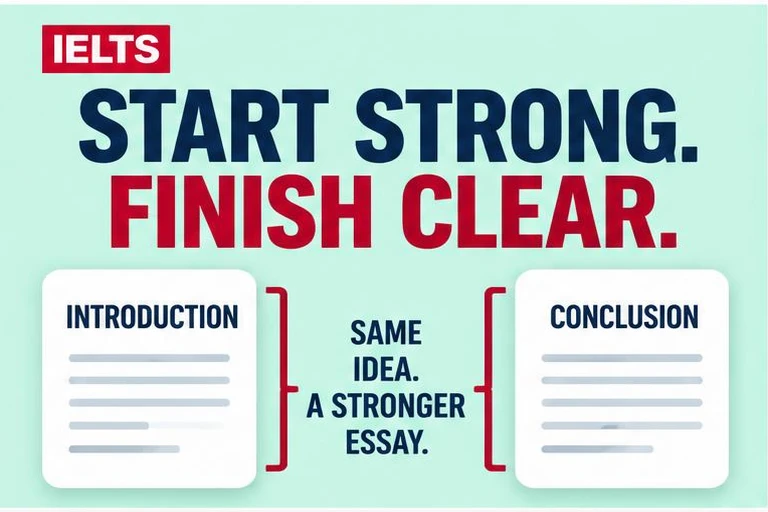
A good introduction paraphrases the question and states your position; a good conclusion restates that position without adding new ideas.
What an introduction must do
A Task 2 introduction has two jobs: paraphrase the question so the examiner knows you understand it, and state your position or outline what the essay will cover. These two or three sentences set expectations for the whole response.
Paraphrasing does not mean replacing every word with a synonym; it means expressing the same idea in your own structure. The position statement can be a clear opinion, a balanced overview, or a preview of the two sides you will discuss, depending on the question type.
Paraphrase example
Question: "Some people think the government should pay for university education." Paraphrase: "Whether higher education should be funded by the state is a topic that divides opinion."
What to avoid in your opening
Memorised opening phrases such as “Nowadays, it is a controversial issue that…” are overused and add no value; examiners notice them immediately and they rarely match the specific question. They also risk sounding irrelevant if the topic does not actually involve controversy.
An introduction that is too long wastes time you need for your body paragraphs. Two or three sentences are enough; there is no need to define every term in the question or to add background history before you have even stated your position.
- Avoid generic templates that could apply to any essay topic.
- Avoid repeating the question word for word.
- Avoid giving detailed examples in the introduction; save them for the body.
- Avoid writing more than three sentences.
Writing a clear thesis statement
Your thesis statement tells the examiner exactly what position you will argue or how your essay is structured. For opinion essays, state your view directly. For discussion essays, state that you will cover both sides, and give your opinion if the question asks for one.
A vague thesis such as “There are many advantages and disadvantages” gives the examiner no sense of direction. A specific thesis shows planning and helps you stay on topic throughout the essay.
- Opinion essay: "This essay will argue that public funding for universities benefits society as a whole."
- Discussion essay: "This essay will examine both arguments before concluding that a mixed funding model is most practical."
- Problem-solution essay: "This essay will outline the main causes of this problem and suggest two practical solutions."
Conclusion do’s and don’ts
A strong conclusion restates your position in different words and briefly summarises your main points. It should never introduce a new argument, example or statistic, since the examiner has no space left to see it developed.
Keep the conclusion short, usually two to three sentences. A conclusion that is too short can look rushed, but one that repeats the introduction almost word for word also loses marks for limited range.
- Do restate your position clearly.
- Do briefly summarise your main supporting points.
- Don’t introduce new ideas or evidence.
- Don’t copy your introduction sentence by sentence.
Before-and-after examples and timed strategy
Before: "In conclusion, there are many advantages and disadvantages to this issue and it depends on the situation." This is vague and adds nothing. After: "In conclusion, while state funding would reduce inequality in access to education, a combination of government support and student contribution offers the most sustainable approach." The revised version is specific and tied to the essay’s argument.
Under exam time pressure, plan to spend around three minutes on your introduction and two minutes on your conclusion, leaving the bulk of your forty minutes for body paragraphs. Draft your thesis statement first, since it guides what your body paragraphs will cover, and write your conclusion last so it accurately reflects what you actually argued.
Time yourself on a full Task 2 essay →Put this into practice
Draft a full essay and get feedback on your introduction and conclusion.
Guest AI tries are limited to one use per feature per day. Sign in for saved progress. AI feedback and band estimates are practice guidance, not official IELTS results.
Official sources and further reading
Practice examples and study routines are illustrative advice, not official band-scored answers or predictions of exam questions.