IELTS Writing Band Descriptors Explained Simply
A plain-English tour of the four IELTS writing criteria, what actually changes between bands 5, 6 and 7, and how to use the descriptors to improve.
By English Grader study guides · AI-assisted educational content · Official sources linked below
The short answer
Understanding the four criteria in plain language makes it easier to see exactly what to improve, not just that your score needs to go up.
The four criteria, in plain English
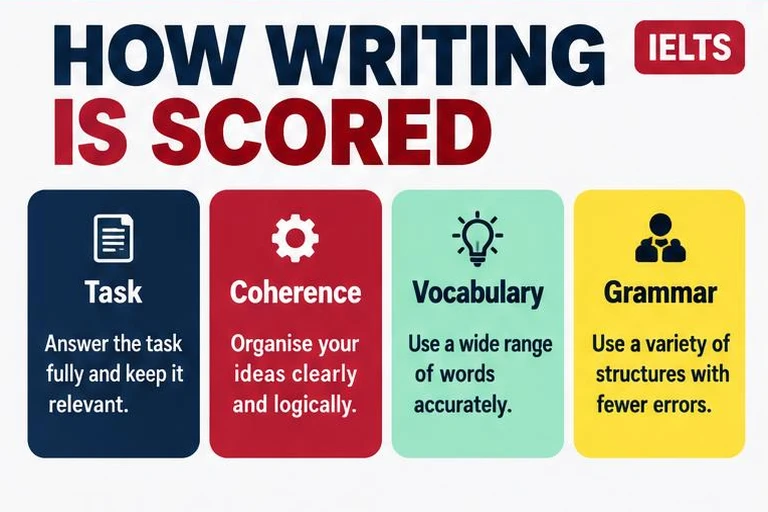
IELTS writing is scored against four criteria, each worth 25% of the writing band: Task Achievement or Task Response, Coherence and Cohesion, Lexical Resource, and Grammatical Range and Accuracy. Examiners use published descriptors for each band to decide where your writing sits on every criterion.
In simple terms: Task Response asks whether you answered the question fully and developed your ideas. Coherence and Cohesion asks whether your writing is organised and easy to follow. Lexical Resource looks at vocabulary range and accuracy. Grammatical Range and Accuracy looks at sentence variety and correctness.
What actually changes between bands 5, 6 and 7
At band 5, ideas are present but may be underdeveloped, repetitive, or only partly relevant, and errors can interfere with understanding at times. At band 6, ideas are relevant and reasonably developed, organisation is clear enough to follow, and errors are present but rarely cause confusion.
At band 7, ideas are well developed with clear progression, a wider range of vocabulary and grammar is used with good control, and errors become occasional rather than frequent. The jump from 6 to 7 is less about new content and more about control, precision and consistency.
- Band 5: basic ideas, frequent errors, limited vocabulary range
- Band 6: clear ideas, generally organised, errors do not block meaning
- Band 7: developed ideas, flexible language, errors are occasional
Using descriptors to self-assess
Rather than reading the full descriptor document once and forgetting it, try checking one essay against one criterion at a time. For example, read only the Coherence and Cohesion descriptors and ask honestly which band your paragraph organisation matches.
This is slower than guessing a single overall score, but it reveals patterns, such as consistently losing marks on grammar while scoring well on task response, which tells you exactly where to focus your study time.
Self-checking cohesion
If your essay uses 'firstly', 'secondly' and 'in conclusion' but paragraphs still feel disconnected, the issue is likely linking between ideas within paragraphs, not just between them, which matches band 6 rather than band 7 descriptors.
Common misreadings of the descriptors
A frequent misunderstanding is that longer essays or more complex vocabulary automatically score higher. The descriptors reward appropriateness and control, not length or difficulty for its own sake; an essay stuffed with advanced words used incorrectly can score lower than a simpler, accurate one.
Another misreading is treating the four criteria as equally easy to improve quickly. Grammar and vocabulary range tend to build gradually over weeks, while task response and structure can often improve faster with focused practice on planning.
Using feedback mapped to the criteria
Generic feedback like 'use better vocabulary' is hard to act on. Feedback that is organised by the four official criteria is more useful, because you can see at a glance whether your main weakness is task response, organisation, vocabulary or grammar.
Over several practice essays, tracking which criterion keeps coming up as the weakest gives you a clear priority list, rather than trying to improve everything at once.
Get feedback organised by the four writing criteria →Put this into practice
Submit an essay and see feedback organised around task response, coherence, vocabulary and grammar.
Guest AI tries are limited to one use per feature per day. Sign in for saved progress. AI feedback and band estimates are practice guidance, not official IELTS results.
Official sources and further reading
Practice examples and study routines are illustrative advice, not official band-scored answers or predictions of exam questions.