How to Paraphrase in IELTS Writing and Speaking
Practical paraphrasing techniques for IELTS — synonym swaps, structure changes, when not to paraphrase, and common errors with worked exercises.
By English Grader study guides · AI-assisted educational content · Official sources linked below
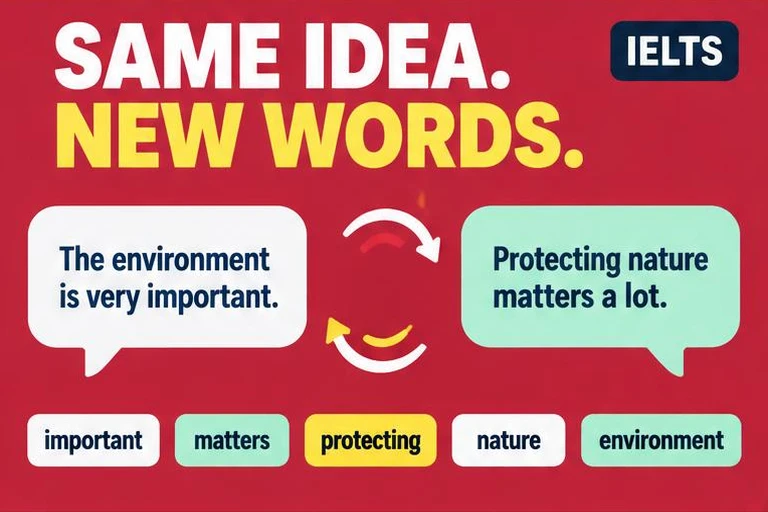
The short answer
Good paraphrasing changes vocabulary and sentence structure together while keeping meaning intact — changing only single words, or paraphrasing technical terms that have no real substitute, usually backfires.
Why paraphrasing matters
In Writing Task 2, your introduction is expected to restate the question in your own words, showing you understood it without simply copying it. In Speaking, paraphrasing a question before answering can also help you buy a moment to think while sounding natural.
Examiners can tell when a sentence is lifted directly from the prompt, and heavy copying limits how high your Lexical Resource score can go, since it shows no independent control of language.
Paraphrasing well is also a transferable skill: it is the same ability you use to avoid repeating the same word three times in one paragraph.
Two core techniques: synonyms and structure changes
The first technique is lexical: replacing key words with accurate synonyms. This only works if the synonym fits the context — “big” and “huge” are not always interchangeable with “significant” or “considerable” in formal writing.
The second, often more effective, technique is structural: changing the sentence pattern itself, for example turning an active sentence into a passive one, or changing a noun phrase into a clause.
The strongest paraphrases combine both techniques at once, rather than relying on synonym substitution alone, which can sound unnatural or even change the meaning if done carelessly.
- Synonym swap: “Many people believe” → “A large number of people are of the opinion that”
- Structure change: “Governments should invest more in public transport” → “Greater investment in public transport is needed from governments.”
- Combined: “Some people think technology has made children less social” → “It is often argued that children have become less sociable as a result of technology.”
When not to paraphrase
Technical or fixed terms should generally be kept as they are rather than forced into a synonym. Words like “renewable energy”, “carbon emissions” or “public transport” have no natural substitute, and attempting one often produces an awkward or inaccurate phrase.
Proper nouns, statistics, and specific names given in a prompt (in Task 1, for instance) should never be paraphrased — changing them risks inaccuracy rather than demonstrating skill.
If you’re unsure whether a term is technical or general, a simple test is to ask whether a native speaker would naturally replace it in conversation; if not, leave it as it is.
Practice exercises with answers
Try paraphrasing the following sentences before checking the suggested answers below. Cover the answers first and compare your version afterwards.
- Original: “Some people think that social media has a negative effect on young people.” Suggested: “It is sometimes argued that social media negatively impacts younger generations.”
- Original: “The graph shows the number of tourists visiting three countries between 2000 and 2020.” Suggested: “The chart illustrates tourist numbers in three countries over a twenty-year period from 2000 to 2020.”
- Original: “Many countries are investing in renewable energy to reduce pollution.” Suggested: “A growing number of nations are channelling funds into renewable energy as a means of cutting pollution.”
Full sentence paraphrase
Original: “Nowadays, more and more people prefer to work from home rather than commute to an office.” Paraphrase: “In recent years, remote working has become increasingly popular compared with commuting to a traditional workplace.”
Common paraphrase errors to avoid
The most frequent error is changing meaning rather than wording — for example, turning “should” into “must”, which shifts a suggestion into an obligation and misrepresents the original claim.
Another is over-paraphrasing simple words that didn’t need changing, which can make a sentence sound unnatural, as well as under-paraphrasing by changing only one word in an otherwise identical sentence.
Finally, grammatical errors introduced while restructuring a sentence are common; always re-read your paraphrase as a standalone sentence to check it still makes sense and is accurate.
Get feedback on your paraphrasing →Put this into practice
Try paraphrasing a Task 2 question and check whether the meaning stays accurate.
Guest AI tries are limited to one use per feature per day. Sign in for saved progress. AI feedback and band estimates are practice guidance, not official IELTS results.
Official sources and further reading
Practice examples and study routines are illustrative advice, not official band-scored answers or predictions of exam questions.