IELTS Opinion Essay Sample: How to Agree or Disagree Clearly
A full sample IELTS opinion essay with paragraph-by-paragraph commentary, plus how to spot opinion questions and avoid the most common position mistakes.
By English Grader study guides · AI-assisted educational content · Official sources linked below
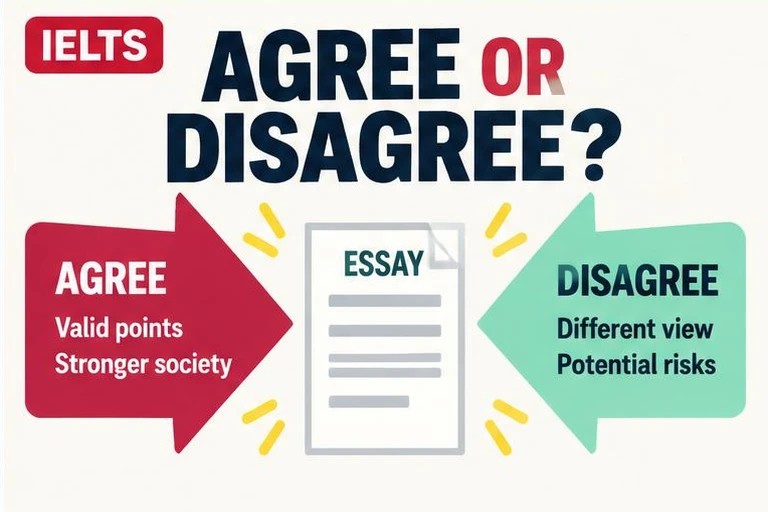
The short answer
An opinion essay only scores well if your position is clear from the introduction and stays consistent to the final sentence.
How to recognise an opinion question
Opinion essays, sometimes called “agree or disagree” tasks, give you a statement and ask what you think about it. They are different from discussion essays, which ask you to look at two sides before giving a brief opinion at the end.
The wording usually gives it away. Phrases like “to what extent do you agree or disagree”, “do you agree or disagree with this statement”, or “what is your opinion” all signal that the examiner wants a clear, argued stance from start to finish, not a balanced weigh-up.
- “To what extent do you agree or disagree?” → opinion essay
- “Discuss both views and give your own opinion” → discussion essay
- “What are the advantages and disadvantages?” → advantages/disadvantages essay
Choosing a position you can actually defend
Pick the side that gives you more to say, not necessarily the one you believe most strongly in real life. You can also choose a partial agreement, such as “largely agree, but with one exception”, as long as this is stated clearly and argued consistently.
Whatever you choose, state it in the introduction in plain language. Avoid vague phrases like “there are many views on this” that leave the reader unsure what you actually think.
Draft an introduction and check your position →Sample essay: should university education be free for all students?
Question: Some people believe that university education should be free for all students, regardless of their family’s income. To what extent do you agree or disagree?
Below is a full sample response of around 270 words, followed by a short breakdown of what each paragraph is doing.
Sample essay
Free university tuition is a policy that several governments have debated in recent years. I largely disagree with the idea that it should apply to all students regardless of income, as I believe limited public funds are better targeted at those who genuinely cannot afford to study. Firstly, offering free tuition to every student, including those from wealthy families, is an inefficient use of taxpayers’ money. Governments typically have finite education budgets, and spending a large share of this on students who could pay for themselves leaves less available for other priorities, such as improving school facilities or supporting students from low-income households with grants and living costs. Secondly, means-tested support, where financial help is given according to need, tends to achieve the stated goal of free education more directly. For example, countries that offer income-based scholarships and loan forgiveness schemes have seen measurable increases in university enrolment among disadvantaged groups, without the same cost to public finances as a universal scheme. However, I accept that a fully free system does have one clear advantage: it removes any stigma or paperwork associated with proving financial need, which can discourage some eligible students from applying for support in the first place. This is a genuine drawback of means-tested models that policymakers should address. In conclusion, while a universal free tuition policy has some merit in terms of simplicity, I believe it is a less efficient use of public resources than a well-designed means-tested system, and therefore disagree with the statement overall.
Why this essay holds together
The introduction states the position in the second sentence, using “I largely disagree”, so the examiner knows immediately what to expect. Every body paragraph then supports that position with a distinct reason rather than repeating the same idea in different words.
The fourth paragraph acknowledges a counterpoint but does not abandon the writer’s stance; it simply admits one limitation before the conclusion restates the original opinion. This is a useful technique for Task Response, since it shows balanced thinking without the position drifting.
- Position stated early and in plain words
- Each paragraph adds a new, separate reason
- A counterpoint is handled without changing sides
- Conclusion restates the opinion using different wording
Common position mistakes to avoid
The most frequent problem is sitting on the fence: writing “both sides have good points” without ever saying which side you actually favour. Examiners cannot credit a clear position if one is never given.
A second common issue is changing position partway through the essay, agreeing in the introduction but effectively arguing the opposite case by the conclusion. Before you submit, reread your introduction and conclusion together and check they say the same thing.
Check your essay for a consistent position →Put this into practice
Write your own agree or disagree essay and get instant AI feedback on your position and structure.
Guest AI tries are limited to one use per feature per day. Sign in for saved progress. AI feedback and band estimates are practice guidance, not official IELTS results.
Official sources and further reading
Practice examples and study routines are illustrative advice, not official band-scored answers or predictions of exam questions.