
IELTS Listening map labelling: directions, landmarks and viewpoint
Track routes and landmarks in IELTS Listening map-labelling tasks, understand left/right viewpoints, and prepare before the recording starts.
By English Grader study guides · AI-assisted educational content · Official sources linked below
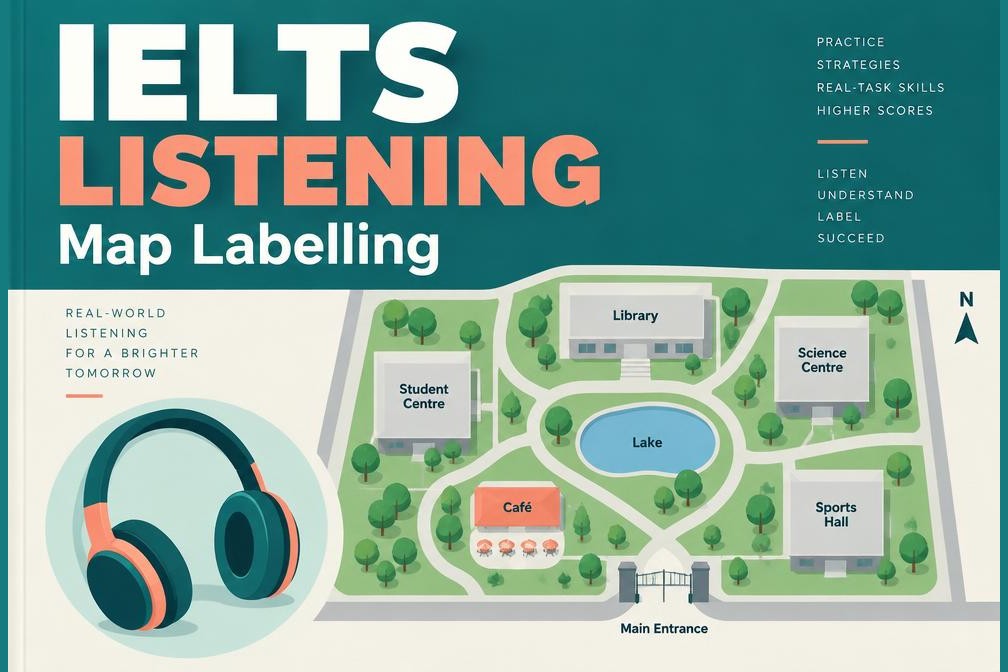
The short answer
Orient yourself before the audio: identify the starting point, landmarks and any north arrow. Follow the speaker’s route instead of guessing from the nearest label.
Inspect the map before following directions
Use available preview time to identify the entrance, paths and existing labels. Check whether a compass arrow is supplied. Not every map has one, so avoid assuming the top is north when orientation is not established. The speaker may describe a route from a specific entrance or from the viewpoint of someone walking.
Distinguish movement directions from fixed locations. Turn left depends on the traveller’s direction of movement; west of the library refers to a fixed compass relationship when a compass is available. Opposite, beside and at the far end describe different positions and should not be treated interchangeably.
- Find the starting point and named landmarks.
- Track turns from the speaker’s viewpoint.
- Check the label against the entire location description.
A worked example: compare meaning with the question
This original illustration explains the decision process. It is not an official IELTS question or a prediction of test content.
Original verbal route illustration
Imagine an entrance at the bottom of a plan with a path leading straight ahead. The speaker says: “Walk along the main path. The café is on your right, immediately before the bridge.” Locate both the side of the path and the position relative to the bridge; “on the right” alone is not enough. This is a written explanation, not an audio/map test.
Avoid losing the next answer after one missed turn
If you lose your place, listen for the next named landmark to reorient. Spending too long reconstructing an earlier route may cause you to miss several subsequent labels. Keep the existing map labels in view so you can reconnect the description to a known location.
During review, redraw the route in a simple sketch and explain each turn. If your sketch matches the audio but your label is wrong, you may have confused the answer format or chosen a nearby building. If the route itself is wrong, focus on direction language and viewpoint.
Transfer location language to another skill
After an official map task, describe the route aloud without the transcript. Then practise an Academic Writing Task 1 map description, where precise location language also matters. The app’s Task 1 tool supports map-report practice; it does not play the Listening recording or mark Listening map answers.
Build IELTS vocabulary for your own answers →Apply what you learn in Writing and Speaking
Use useful language from your listening review in your own spoken answer. Record a fresh response, listen back and review development, vocabulary and grammar. Speaking feedback does not replace an official Listening test or answer key.
The tools here provide AI practice feedback and band estimates for Writing and Speaking, not official results. Use a relevant original answer, review a specific weakness and try again. For Reading and Listening tests, use official preparation materials with their audio, passages and answer keys.
Practise IELTS Speaking with feedback →Related guide: IELTS Listening word limits: one word, numbers and extra information
Put this into practice
Use the existing Writing, Speaking and Vocabulary tools alongside official Reading and Listening preparation. This site provides educational guides for Reading and Listening, not tests or automated marking for those skills.
Guest AI tries are limited to one use per feature per day. Sign in for saved progress. AI feedback and band estimates are practice guidance, not official IELTS results.
Official sources and further reading
Practice examples and study routines are illustrative advice, not official band-scored answers or predictions of exam questions.