
IELTS Listening word limits: one word, numbers and extra information
Check IELTS Listening answer limits and response format, avoid adding unnecessary words, and understand why a correct idea can still lose a mark.
By English Grader study guides · AI-assisted educational content · Official sources linked below
The short answer
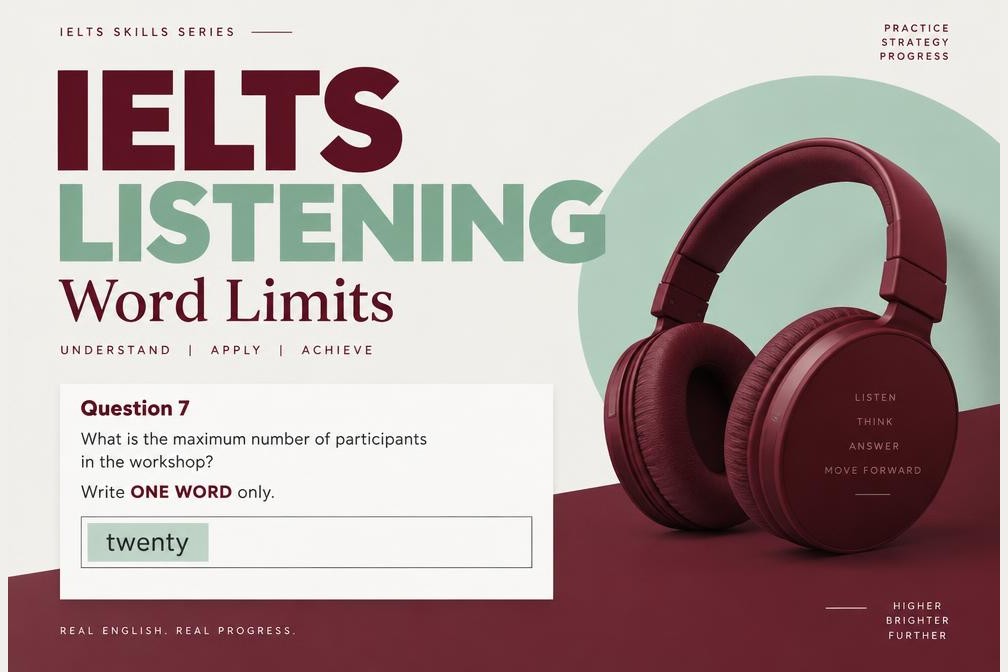
Answer in the format requested and stay within the stated limit. A correct detail with extra words can be marked wrong; more information is not automatically safer.
Treat the instruction as part of the question
Completion tasks may ask for one word, up to two words, or words and/or a number. Read the instruction for the current question group rather than carrying a rule over from a previous set. If a task specifies ONE WORD ONLY, you cannot add an article or an explanatory phrase just because it sounds natural.
The printed sentence provides context. A heading such as arrival time tells you what the gap represents; it does not necessarily need to be repeated in the answer. Your aim is to supply the missing information, not rewrite the entire statement.
- Check the limit for each question group.
- Do not copy words already provided around the gap.
- Use the requested letters, words or numbers.
A worked example: compare meaning with the question
This original illustration explains the decision process. It is not an official IELTS question or a prediction of test content.
Original limit example
Instruction: Write ONE WORD ONLY. Notes: Equipment to bring: _____. Speaker: “Please bring a notebook. We supply the pens.” Answer: notebook. “a notebook” exceeds the one-word limit. “Pens” is mentioned but does not answer what the participant must bring.
Check spelling and grammar after listening
When review time is available, check that the answer fits the completed phrase. Plural endings can matter when the recording and sentence require them. Do not change an answer only because a different word sounds more elegant; the task is about accurate comprehension and instructions.
Official IELTS explains that hyphenated words count as single words for relevant completion tasks. Do not invent hyphens to force a long phrase into a limit. Follow the actual word form and official task guidance. Contractions and number formats should likewise be handled according to the task rather than improvised rules.
Audit instructions separately from comprehension
In your next official practice set, keep two totals: answers with the correct meaning and answers accepted by the key and instructions. If the difference is caused by excess words or spelling, improve your final check instead of assuming you need more difficult audio. Use short vocabulary retrieval exercises to make accurate written forms more automatic.
Build IELTS vocabulary for your own answers →Apply what you learn in Writing and Speaking
Use useful language from your listening review in your own spoken answer. Record a fresh response, listen back and review development, vocabulary and grammar. Speaking feedback does not replace an official Listening test or answer key.
The tools here provide AI practice feedback and band estimates for Writing and Speaking, not official results. Use a relevant original answer, review a specific weakness and try again. For Reading and Listening tests, use official preparation materials with their audio, passages and answer keys.
Practise IELTS Speaking with feedback →Related guide: IELTS Listening spelling and numbers: names, dates and endings
Put this into practice
Use the existing Writing, Speaking and Vocabulary tools alongside official Reading and Listening preparation. This site provides educational guides for Reading and Listening, not tests or automated marking for those skills.
Guest AI tries are limited to one use per feature per day. Sign in for saved progress. AI feedback and band estimates are practice guidance, not official IELTS results.
Official sources and further reading
Practice examples and study routines are illustrative advice, not official band-scored answers or predictions of exam questions.