
IELTS grammar mistakes to avoid for Band 8 writing
The grammar mistakes that keep IELTS Writing at Band 6.5—articles, subject-verb agreement, sentence fragments and comma splices—and how to fix each one.
By English Grader study guides · AI-assisted educational content · Official sources linked below
The short answer
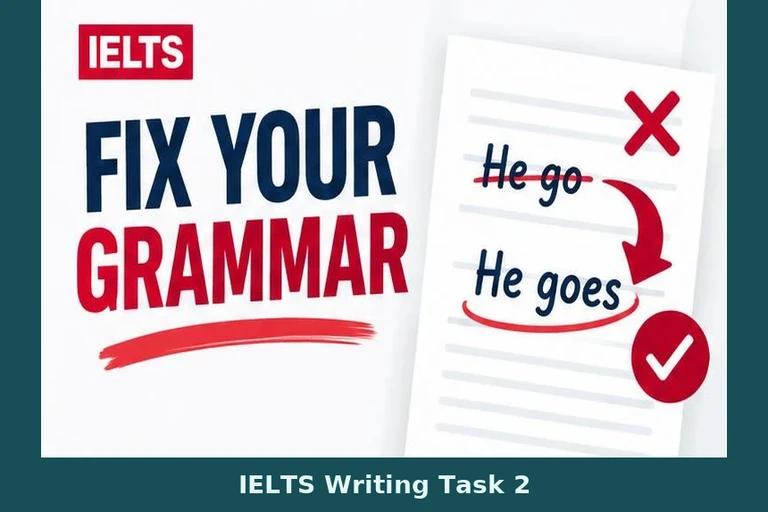
Band 8 grammar means 'the majority of sentences are error-free'—you do not need perfect English, you need to eliminate your three most frequent errors.
Articles: a, an, the
Article errors are the most common mistake at Band 6.5. The rule that fixes most cases: use 'the' when the reader knows which one you mean; use 'a/an' for first mention of something countable.
'The government should invest in the public transport' is wrong—'public transport' is uncountable and general, so no article.
- First mention: 'a university'
- Known to reader: 'the university I attended'
- General plural/uncountable: no article
Subject-verb agreement
Long subjects hide the real noun: 'The number of students who study abroad have increased' is wrong—'the number... has increased'.
Watch for 'one of the + plural noun + singular verb': 'One of the biggest problems is...'
Related guide: More grammar mistakes
Fragments and comma splices
A fragment is an incomplete sentence: 'Because the cost of living is rising.' cannot stand alone.
A comma splice joins two sentences with only a comma: 'The population is growing, this causes problems.' Use a full stop, a conjunction, or a semicolon.
- Fragment fix: attach it to the main clause
- Splice fix: full stop, 'which', or 'and/but/so'
Practise
Submit an essay and count how many of these three errors appear—then rewrite those sentences.
Start Writing Task 2 →Put this into practice
Submit an essay and see exactly which grammar errors are limiting your band.
Guest AI tries are limited to one use per feature per day. Sign in for saved progress. AI feedback and band estimates are practice guidance, not official IELTS results.
Official sources and further reading
Practice examples and study routines are illustrative advice, not official band-scored answers or predictions of exam questions.