IELTS vocabulary for Writing Task 2: learn phrases you can actually use
Improve IELTS Writing Task 2 vocabulary with topic phrases, natural collocations, example sentences, and a learn–recall–apply practice routine.
By English Grader study guides · AI-assisted educational content · Official sources linked below
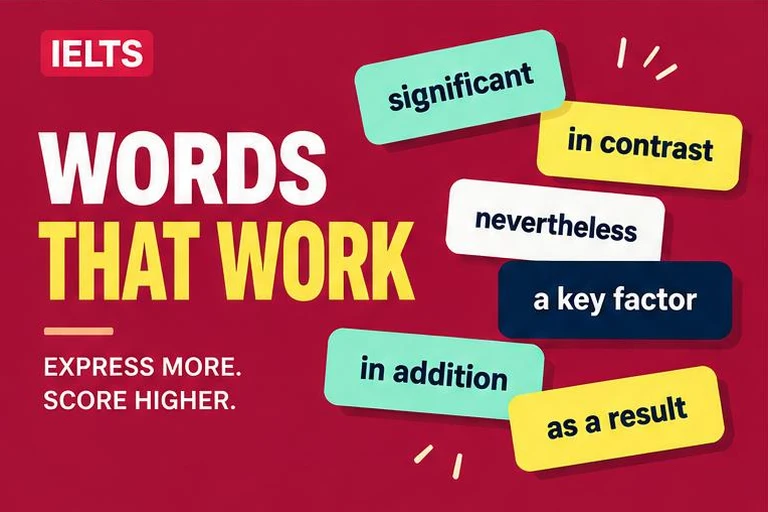
The short answer
Learn a word’s meaning, its natural partners, and a sentence that answers a real essay question. Accurate, relevant wording is more valuable than inserting impressive-looking words.
Why a list of ‘high-band words’ is not enough
IELTS Writing assesses Lexical Resource, including vocabulary range, precision, appropriacy, and control of spelling and word formation. A difficult word used inaccurately can make your meaning less clear. No single word belongs to a guaranteed band, and a vocabulary list cannot predict your score.
The band-labelled lists in this app are study groupings, not official IELTS classifications. Use them to organise practice rather than as a requirement to include a set number of advanced words. If a simpler phrase says exactly what you mean, keep it.
Useful topic phrases—with meaning and context
Learn collocations: words that naturally appear together. Start with a small set tied to an essay topic, and notice what each phrase lets you explain. The examples below are practice sentences, not extracts from scored essays.
- Education — equal access to education: ‘Public funding can help provide equal access to education in rural areas.’
- Environment — reduce household waste: ‘Clear recycling guidance can help residents reduce household waste.’
- Technology — protect personal data: ‘Companies should explain how they protect personal data.’
- Work — flexible working arrangements: ‘Flexible working arrangements may help parents balance work and childcare.’
- Cities — affordable housing: ‘Investment in affordable housing can ease pressure on low-income households.’
Check word partners and word forms
A translation can tell you the broad meaning but not always how to use the word in English. Record the common verb or preposition alongside the word. Then check whether your sentence needs a noun, adjective, or verb.
- Write a natural partner: make a decision; address a problem; invest in education.
- Learn one related word form: benefit, beneficial; access, accessible.
- Create your own sentence and verify that the phrase fits its intended meaning.
Practice corrections
‘do a decision’ → ‘make a decision’ ‘beneficial for reduce pollution’ → ‘beneficial for reducing pollution’ ‘people can convenience’ → ‘people can benefit from greater convenience’
Turn translation matching into usable essay vocabulary
Recognising a translation is a first step, not proof that you can use the word accurately. Review a topic list, hide the translation and recall the meaning, then write a sentence without copying the example. Later, use a few relevant phrases in a paragraph that answers an actual Task 2 question.
English Grader includes word lists, flashcards, and matching practice in your selected translation language when translations are available. Matching can be filtered by the list’s band groupings. After a match, say or write an English sentence so the activity goes beyond recognising a pair of words.
- Learn: choose five useful phrases from one topic.
- Recall: hide the definitions, or use flashcards and matching.
- Apply: write a short paragraph using only phrases that fit the argument.
- Review: revisit mistakes and try a new question with the same topic language.
Check your vocabulary in a complete answer
Do not replace every repeated topic word: sometimes repetition is clearer than an awkward synonym. Also avoid inserting memorised phrases that have little connection to the argument. The best test is whether your wording helps the reader understand a specific point.
When you have written a paragraph or essay, use writing feedback to review vocabulary in context alongside task coverage, organisation, and grammar. Start with the available free practice and choose a higher allowance only if it supports a consistent learning routine.
Apply your vocabulary in a Task 2 essay →Put this into practice
Choose a topic, review the word list, then test your recall with flashcards or translation matching before using the words in an essay.
Guest AI tries are limited to one use per feature per day. Sign in for saved progress. AI feedback and band estimates are practice guidance, not official IELTS results.
Official sources and further reading
Practice examples and study routines are illustrative advice, not official band-scored answers or predictions of exam questions.