IELTS Writing Task 1 vocabulary for trends: rise, fall, fluctuate and more
Precise IELTS Task 1 vocabulary for describing trends—verbs, nouns, adverbs and adjectives—with example sentences and common mistakes.
By English Grader study guides · AI-assisted educational content · Official sources linked below
The short answer
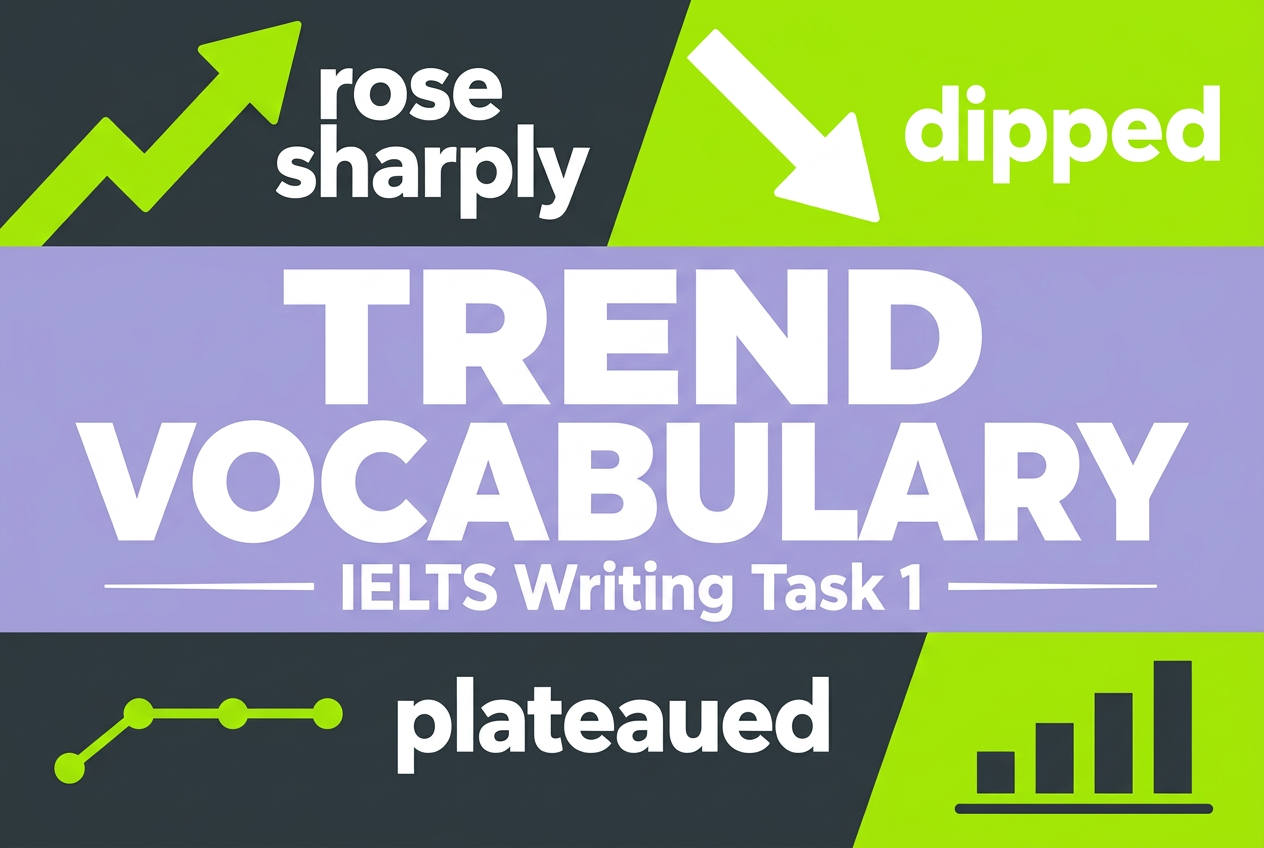
Vary the grammar, not just the words: switch between verb + adverb ('rose sharply') and adjective + noun ('a sharp rise').
Trend verbs and nouns
Learn these in pairs so you can change sentence structure.
- rise / a rise, increase / an increase, climb
- fall / a fall, decline / a decline, drop / a drop
- fluctuate / a fluctuation
- level off, plateau, remain stable
- peak at / reach a peak of
- hit a low of / bottom out
Related guide: See trend words in a line graph report
Describing speed and size
Adverbs and adjectives show how much and how fast.
- sharply / a sharp, dramatically / a dramatic
- steadily / a steady, gradually / a gradual
- slightly / a slight, marginally / a marginal
Two ways to say it
Sales rose sharply to 80 units in 2020. There was a sharp rise in sales, which reached 80 units in 2020.
Common mistakes
These errors lower Lexical Resource and Grammar.
- 'increased of 10%' → increased by 10%
- 'a sharply rise' → a sharp rise
- Using 'dramatically' for small changes
- Describing a table with no time period as a trend
Practise
Write one report using at least three verb + adverb and three adjective + noun patterns.
Write a Task 1 report →Put this into practice
Pick a line graph or bar chart from the Task 1 bank, write your report, and check feedback on vocabulary range.
Guest AI tries are limited to one use per feature per day. Sign in for saved progress. AI feedback and band estimates are practice guidance, not official IELTS results.
Official sources and further reading
Practice examples and study routines are illustrative advice, not official band-scored answers or predictions of exam questions.