
IELTS writing checker for teachers: a faster feedback workflow
Use an IELTS writing checker to draft feedback, review band estimates and give students focused revision targets without replacing teacher judgement.
By English Grader study guides · AI-assisted educational content · Official sources linked below
The short answer
Let AI prepare a first-pass analysis; spend your teaching time checking the evidence, explaining the biggest weakness and setting a revision task.
What should an IELTS writing checker do for a teacher?
A checker is most useful when it reduces repetitive diagnosis, not when it replaces your judgement. Finding repeated article errors and drafting an explanation can be routine; deciding whether an argument genuinely answers the question still needs careful reading. A long list of corrections is not necessarily a useful lesson.
English Grader offers AI-assisted marking alongside teacher-entered bands and feedback. Treat the generated report as a draft assessment. You can use it to locate likely problems, then decide which observations are accurate and which matter most for this student.
Review AI-assisted IELTS marking →Prepare the question and original response first
Keep the exact question with the response. An essay about transport cannot be assessed for Task Response without knowing whether the task asked for an opinion, both views or solutions. Preserve the student's original draft; editing it before assessment changes the evidence.
For a manageable first trial, choose one class task and a few responses. Check that each answer belongs to the correct student and that the task type is correct. Teacher tools require a teacher account; guest practice is a separate way to try the public tools.
- Confirm the student and class.
- Include every instruction in the task question.
- Check extracted text against any uploaded original.
- Keep the first draft separate from a later revision.
Review task coverage before sentence corrections
Read the response once for meaning before inspecting individual edits. Has the student answered the whole question? Is the position consistent? Are examples developed enough to support the claim? Then compare your reading with the AI comments. Reject a suggested change if it introduces a new idea or changes the student's intended meaning.
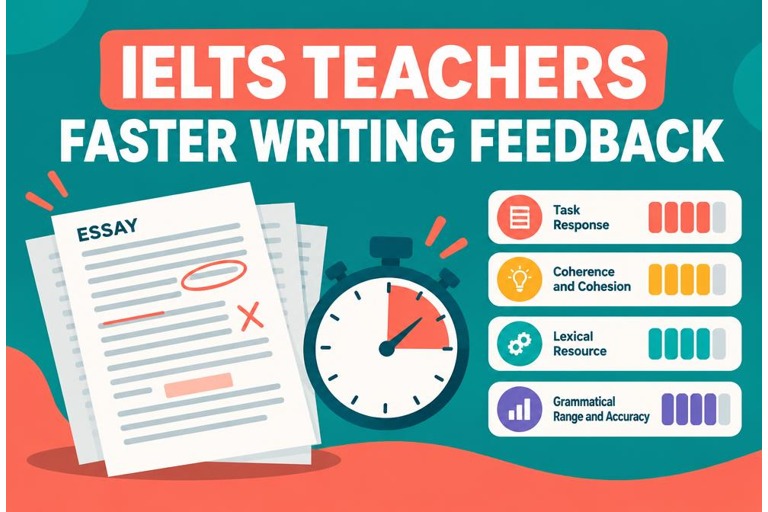
Writing assessment includes Task Achievement or Task Response, Coherence and Cohesion, Lexical Resource, and Grammatical Range and Accuracy. Use these headings to organise feedback, but avoid presenting a practice estimate as an official IELTS result.
Related guide: Connect band estimates to evidence
Replace vague comments with a next action
A reusable feedback structure is: evidence, explanation, action. Cite one sentence, explain its effect on the reader and give a short revision instruction. This is easier for students to act on than a page of general advice.
Illustrative teacher comment—not a scored response
Your second paragraph says public transport is convenient, but does not explain how. Add a specific commuting situation and explain why frequent services make that journey easier. Keep the example connected to your opinion.
Measure your own time savings
Do not assume every submission will be quicker to mark. Unclear scans or questionable AI corrections can add review work. Time a small group of comparable essays with and without the tool, including preparation, checking and writing your final comment. Compare feedback quality as well as elapsed time.
Once you have a workable routine, students can use the public Writing practice tools for further attempts. Signed-in submissions and teacher reports can support follow-up; confirm current allowances on Plans before expanding your routine.
Try IELTS Writing Task 2 practice →Put this into practice
Sign in with a teacher account, review a student submission and compare the AI analysis with your own reading before saving your grade and comments.
Guest AI tries are limited to one use per feature per day. Sign in for saved progress. AI feedback and band estimates are practice guidance, not official IELTS results.
Official sources and further reading
Practice examples and study routines are illustrative advice, not official band-scored answers or predictions of exam questions.